What Is a Company Brain? One Place for All That Your Business Knows

Key Takeaways
- A company brain is one place that holds your knowledge, your team, your rules and your connected apps.
- Today AI is one person and one chat. Each person explains the business again.
- 5 Memox products run on the brain: the website chatbot, the voice agent, the CRM, handoff to your team and the Memox app.
- Change one fact once. The chatbot, the phone line, the CRM, the handoff and the app all use it.
- Start with 1 product for the problem you have now. Add the next one later.
Your chatbot gives one price. Your phone gives another. Your newest rep gives a third. A company brain ends this. It is one place that holds your knowledge, your team, your rules and your connected apps. Your chatbot, your phone line and your team's assistant all work from it, so each one starts with your business already known.
One brain for your company. It answers your customers, your phone and your team.
This post defines the term, shows what goes into a brain, and explains why it matters. It also shows how to build one in 7 steps.
AI today is one person and one chat
Most people use AI like this. One person opens one chat. They type who they are, what the business does and what they need. The AI answers. The chat ends.
The next day, the same person types it all again. A colleague does the same in another chat. A third person does it on a phone.
Each chat starts from zero. The knowledge of the business stays in mail, files, chat threads and heads. The AI never holds it for the company.
This works for one person with one task. It breaks when a company must do three things at once:
- Answer customers at 2 am.
- Pick up the phone line.
- Keep a team of 80 people aligned.
Say a 60-person firm has 3 AI tools. The sales person told one tool the new price. The support person did not tell the other two. A customer now hears 3 different prices. This is not an AI fault. It is a missing shared base.

The picture shows the idea. Every room in the building uses the same light. A company brain is that one light source for your tools.
What goes into the brain
A brain holds 4 kinds of content. Each kind has an owner. The owner keeps it correct.
| Part | Examples | Who owns it |
|---|---|---|
| Knowledge | Your website, price rules, policies, the answers your team gives | The owner and the team leads |
| Team | Members, roles (owner, admin, member), which rep owns which customer | The owner or an admin |
| Rules | What the AI may do alone, what needs a person, who gets a handoff | The owner or an admin |
| Connected apps | Mail, calendar, files, your store, your CRM, team chat | The person who connects each app |
Read the table by row. The first row is the one most people think of. The other three rows are what turn a pile of answers into a brain.
Knowledge
Knowledge is what you already say to customers. Your website says it. Your price rules say it. Your team repeats it in mail every week. The brain reads these sources so nobody types them in again.
Team
A brain knows who works in the company and what each person does. This matters for handoffs. When a customer needs a person, the brain must know which person. It uses the customer's own rep from the CRM first.
Rules
Rules set the limits. The AI answers from your knowledge. When the knowledge does not cover a question, the AI says so and offers a person. In the Memox app, you approve each email and each invite before it goes. The AI does not send on its own.
Connected apps
You keep the tools you use. 11 apps connect: Outlook mail, Outlook Calendar, OneDrive, Gmail, other email (IMAP and SMTP), Shopify, GitHub, Jira, HubSpot, Slack and Google Chat. The Memox team sets up each connection hands-on with you.
The picture in 3 layers
Think of the brain as the middle layer. Products sit above it. Your apps sit below it.
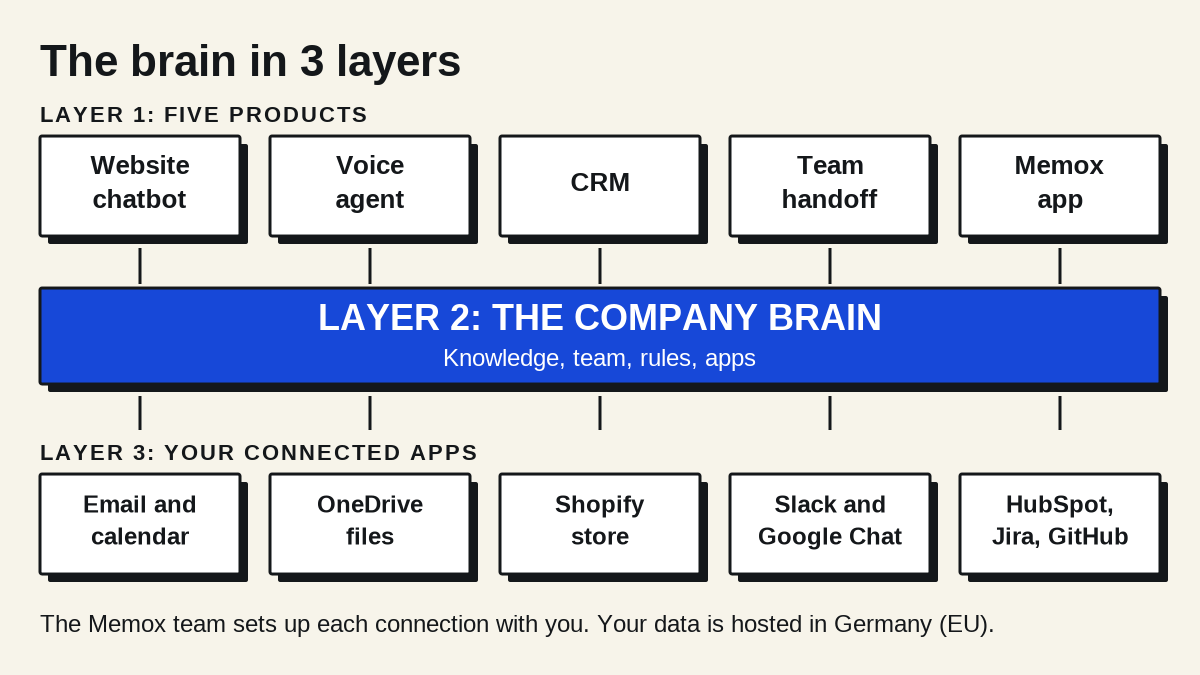
Layer 1 is what people touch: the chatbot, the phone line, the CRM, the handoff and the Memox app. Layer 2 is the brain. Layer 3 is the apps that already hold your data.
Information flows both ways. The apps feed the brain. The brain feeds the products. The products send their results back, for example a new contact in the CRM.
The key point is the middle layer. Without it, each product connects to each app on its own. That is many small links to build and to keep correct. With a brain, each product connects once, and each app connects once.
The 5 products that run on it
Memox builds 5 products on the brain. Each product solves one problem. You can start with one.
| Product | What it does | How to try it |
|---|---|---|
| Website chatbot | Answers visitors day and night from your knowledge. Captures name and contact | Add it to your site with 1 line of code from the Embed tab |
| Voice agent | Picks up your business line in seconds. Keeps a recording and a transcript of each call | Call +1 (573) 490-0128, or call in your browser on /demo |
| CRM | Turns each chat and each call into a contact with a stage and a timeline | Comes with the chatbot and the voice agent. Nobody types it in |
| Handoff to your team | Picks the right rep and tells them. The visitor sees "A rep has been asked" | Turn on "receive handoffs" for each rep |
| The Memox app | Your own AI assistant for the work. Drafts replies. You approve each one | Get the Memox app. Type your website and wait about 1 minute |
Website chatbot
The website chatbot answers visitors from your knowledge. It matches your brand colors and tone. It captures the visitor's name and contact. You read the full chat log. Your team can take over any open chat. It goes on your site with 1 line of code.
Voice agent
The voice agent picks up your business line in seconds, day and night. It answers from the same knowledge as the chatbot. You get a new number or port your own. When a caller needs a person, the call goes to a follow-up list with a status.
CRM
The CRM fills itself. Every chat and every call becomes a contact with a stage and a timeline. Nobody types it in. HubSpot syncs both ways, and the Memox team sets this up with you. Read more in a CRM that fills itself.
Handoff to your team
Handoff gives a chat to the right person. It picks the customer's own rep from the CRM first, and the rep gets a push and an email. The 4 steps are in human handoff from AI chat.
The Memox app
The Memox app runs on iPhone, Android and the web. It is your own assistant for the work. It answers from your mail, calendar, files and store. It drafts replies and runs routines and morning check-ins. Read the Memox app: your own AI assistant.
A company brain is not a knowledge base
One brain for your company.
It answers your customers, your phone and your team. Book a call: we answer your questions live, on your own website.
Many buyers hear "brain" and think "knowledge base". These are different tools.
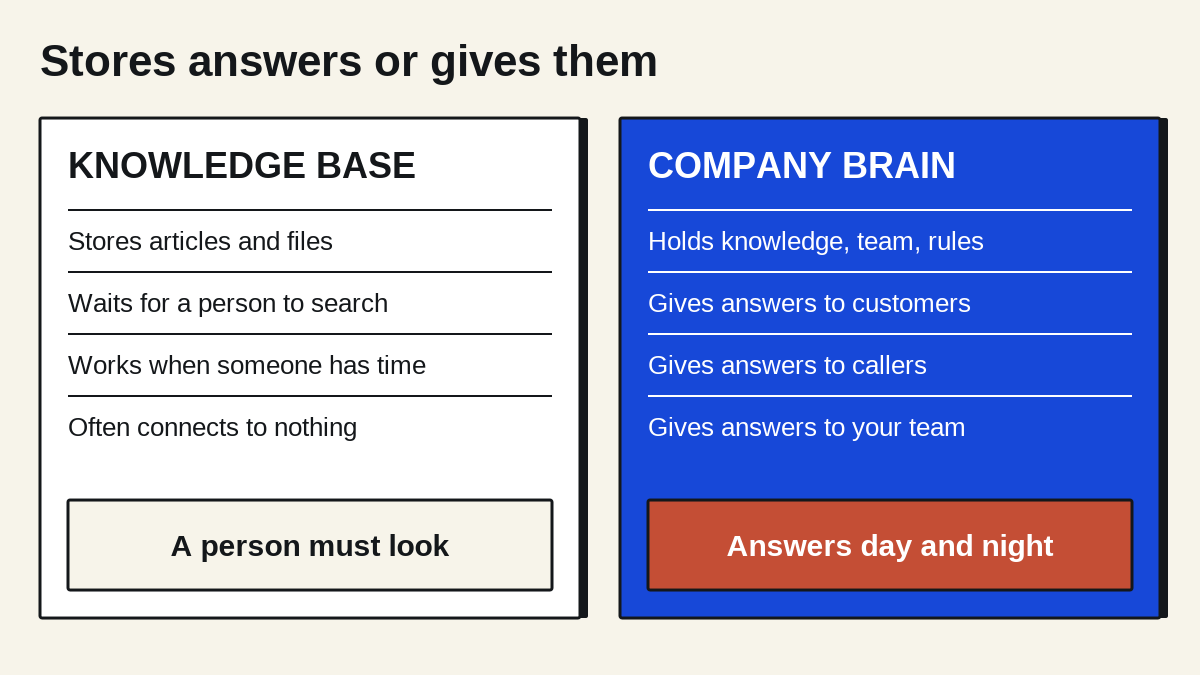
A knowledge base stores articles and files. It waits. A person must search, find the page and read it. If nobody has time, nothing happens.
A company brain gives the answer to the person who asks. That person can be a customer on your site at 2 am, a caller on the phone, or a teammate in the app. The brain also knows who the team is and when to bring in a person.
A knowledge base is a good start. Many teams have one, and it can be a source for the brain. The brain adds the part that acts.
Not a personal AI chat
A personal AI chat is built for one person. It holds that person's conversation. It does not hold the company's rules, the team's roles or the customer list. When that person leaves, the context leaves too.
A company brain is built for the company. It stays when people change. For the full side by side, read AI for the whole team, or one chat for each person?
Not a pile of separate AI tools
Some firms buy one AI tool for chat, one for calls and one for notes. Each tool holds its own copy of the facts. The copies drift apart.
This is a category problem, not a quality problem. Any tool that keeps its own copy can drift. The fix is one copy that every product reads. That copy is the brain.
Think about the cost of this drift. A customer who hears two prices does not blame the tool. They blame your company. They may ask for the lower price, or they may leave. Your team then spends time on a call to repair trust. One shared base removes the cause.
How to choose AI tools for business
The list of AI tools for business is long. A buyer needs a test, not a list. Ask 4 questions about each tool.
- Who uses it? One person, or the whole company? A tool for one person cannot answer your customers.
- Where does it learn your business? From a chat that one person typed, or from your website, your rules and your apps?
- What happens when it does not know? A good tool says so and offers a person. A weak tool guesses.
- Does it share facts with your other tools? If you change a price, does every tool know?
Score each tool with a yes or no on each question. A tool with 4 yes answers can sit on a brain. A tool with 1 yes answer is a side project.
This test also shows why order matters. Buy for the problem you have now. Then check that the next tool can read the same facts. If it cannot, you will pay for the same explanation twice.
Book a 30-minute call. We look at where your leads and customer questions come from today. We show Memox answering on your own website, live on the call. You leave with a plan: what we set up first and which of your tools we connect. Book the call
One fact, five places
Here is the clearest way to see the value. Take an invented business: a florist chain with 12 shops and a fleet of vans. Say the delivery price changes from 8 dollars to 10 dollars on Monday.
Without a brain, the head of operations must update many places:
- The website page.
- The chatbot answers.
- The script for the phone line.
- The notes in the CRM.
- The message the team sends by mail.
The head of operations forgets one. A caller hears 8 dollars on Tuesday. The chain then argues about the price with a customer who was told the old one.
With a brain, the head of operations changes the fact once. Then:
- The website chatbot quotes 10 dollars to the next visitor.
- The voice agent quotes 10 dollars to the next caller.
- The CRM timeline shows what each contact was told.
- A handoff reaches a rep who sees the same price.
- The team asks the Memox app and gets 10 dollars.
One fact, five places. That is the whole benefit in one line. It saves time, and it protects trust. A customer hears the same answer on the web, on the phone and from your rep.
Two more examples
These examples are invented. They show what each business puts in first.
A 120-person HVAC firm
Say the firm gets 30 calls a day. Many calls come at night when a heater fails. Today they go to voicemail, and some callers ring a rival.
What goes in first: service areas, call-out fee rules, opening hours, and which jobs are emergencies.
First product: the voice agent. It picks up in seconds and answers from the rules. A caller who needs a technician goes to the follow-up list with a status.
Next: the CRM, so each call becomes a contact. Then handoff, so a chat on the website reaches the dispatcher.
Read how the phone side works in an AI voice agent for inbound calls.
A furniture retailer with 2 branches
Say the shop sells online and in 2 stores. Visitors ask the same questions every day: stock, delivery time, assembly, returns.
What goes in first: the website, the delivery and returns policy, the price rules, and the Shopify store connection.
First product: the website chatbot. It answers day and night and captures the visitor's name and contact. A visitor who wants a person is handed to a rep at the right branch.
Next: the Memox app for the head of sales, so questions from mail and the store are drafted for approval.
Both firms use the same brain idea. They start with the problem that costs them most.
How to build your company brain
Follow these 7 steps. Allow an afternoon for steps 1 to 4.
- List what you know. Write the 20 questions that customers ask most. Write the answers in plain words. Add the price rules and the policies. Your team has these in mail already.
- Type your website. In the Memox app, type your site address. The app reads it and learns what your business does in about 1 minute. Check what it learned.
- Add your rules. Decide what the AI may answer alone. Decide when it must offer a person. Decide who gets handoffs.
- Invite the team. Give each person a role: owner, admin or member. Each person keeps a private chat.
- Connect your tools. Pick the apps that hold your data, for example mail, your store or HubSpot. The Memox team sets up each connection hands-on with you.
- Pick the first product. Choose the one that fixes today's biggest problem. Switch it on and test it with real questions.
- Review every month. Read the chat log and the call transcripts. Find the questions the brain could not answer. Add those answers. The brain grows from this loop.
Step 7 is the one that matters most. A brain is not finished on day one. It improves as you add what customers really ask.
Control: who sees what
A brain holds the company's knowledge. It must also respect the person. Memox sets limits on both sides.
- 3 roles. Owner, admin and member. An owner or admin turns "receive handoffs" on or off for each member.
- Private chats. Each person keeps a private chat with the assistant.
- Private sources. Raw emails and file text stay private to the person who connected them.
- Approval. You approve each email and each invite before it goes. The assistant does not send on its own.
- Full logs. You read the full chat log of the website chatbot. Voice calls keep recordings and transcripts.
The company shares what it chooses to share, such as the price rules and the policies. A person's mail stays that person's mail.
Proof: ContainerOne
ContainerOne, an online container dealer, uses the Memox website chatbot. In the 30 weeks to 27 Apr 2026, it had 797 chats and 734 leads. The AI alone handled 90.6% of the chats, and 75 handoffs each had a rep assigned. That is the pattern a brain makes possible: the AI answers what it knows and passes on the rest. Read the ContainerOne case study and a website chatbot with human handoff.
Common mistakes
- Starting with all 5 products. Teams try to switch on everything in a week. Quality drops. Fix: pick 1 product for the problem you have now.
- Loading old, wrong answers. If the source is out of date, the brain repeats it. Fix: check your website and price rules before you start.
- Skipping the rules. Without rules, nobody knows when the AI should offer a person. Fix: write the handoff rules in step 3.
- No owner for each part. Knowledge goes stale when nobody owns it. Fix: name an owner for each row of the table above.
- Never reading the logs. The chat log shows the gaps. Fix: review it every month and add the missing answers.
- Treating the brain as a knowledge base. A store of articles does not answer a caller. Fix: connect the products that give the answers.
- Connecting tools alone. Each app has its own set up. Fix: ask the Memox team to set up each connection with you.
Where to start
Pick 1 product for the problem you have today. If visitors wait for answers, read about the website chatbot. If calls go to voicemail, read about the voice agent. If you answer everything yourself, read about the Memox app.
The platform page shows how the layers fit. The universe draws the brain and its products on one map. To hear the voice agent, call +1 (573) 490-0128, or call in your browser on the demo page.
Book a 30-minute call
- We look at where your leads and customer questions come from today.
- We show Memox answering on your own website, live on the call.
- You leave with a plan: what we set up first and which of your tools we connect.
If it fits, our team does the setup with you. We connect your tools, train the brain on your business and hand you a working system. You do not learn AI.
Each setup is hands-on, so we price it to your business. You get a clear quote after the call.
One brain for your company.
It answers your customers, your phone and your team. Book a call: we answer your questions live, on your own website.
Frequently Asked Questions
A company brain is one place that holds what your business knows: your knowledge, your team, your rules and your connected apps. Every product works from it, so each one starts with your business already known.
No. A knowledge base stores answers and waits for a person to search. A company brain gives answers to customers, callers and your team, and it connects to the tools you already use.
Pick the tool for the problem you have now: a chatbot for site visitors, a voice agent for calls, or an assistant for the team. Tools that share one brain stay consistent. Separate tools each need the business explained again.
The website chatbot, the voice agent, the CRM, handoff to your team and the Memox app. All five run on one brain, so one change to a fact reaches every product.
No. Start with the product that fits your biggest problem. Add the next one when you are ready. The brain stays the same.
11 apps connect: Outlook mail, Outlook Calendar, OneDrive, Gmail, other email, Shopify, GitHub, Jira, HubSpot, Slack and Google Chat. The Memox team sets up each connection hands-on with you.
Your data is hosted in Germany (EU). Each person keeps a private chat, and raw emails and file text stay private to the person who connected them. A data processing agreement (DPA / AVV) is available.