Lead Routing: How to Send Each New Enquiry to the Right Person

Written by the co-founder of Memox. Memox sells the product described here. 5 min read.
Short answer
Lead routing decides which person on your team gets each new enquiry, from a web form, a chat or a call. Good lead routing sends a returning customer to their own salesperson first, because that person already knows the order. If that person is away, the enquiry goes to a free colleague.
- The order: the customer's own salesperson, then a free colleague on the same team, then the next free person.
- You choose: the chat waits for the own salesperson, or it passes to the team.
- The chat tells the customer that the team knows, and it does not claim a person is there before one replies.

Lead routing decides which person on your team gets each new enquiry. The enquiry can come from a web form, a website chat or a phone call. A simple rule gives it to whoever is free. A better rule asks first: does this customer already have a salesperson?
That question matters for a returning customer. Their own salesperson (also called the rep or the account manager) knows the quote, the delivery date and the last problem. A stranger does not, so the customer must explain everything again.
Speed matters too. In 2011, Harvard Business Review published a study of online sales leads by Oldroyd, McElheran and Elkington. The authors wrote that "most companies are not responding nearly fast enough" (source). Good lead routing sends each enquiry straight to a person who can reply.
What is lead routing?
Lead routing is a set of rules. Each rule reads a new enquiry and picks a person. There are 3 common rules:
- Round robin. Each new enquiry goes to the next person in turn. This is fair to your team.
- By region or product. The enquiry goes to the team that covers that area.
- By owner. Your CRM (the system that holds your customer list) names the customer's own salesperson. The enquiry goes to that person first.
Round robin works well for a new visitor. A new visitor has no history, so any good salesperson is the right one. For a returning customer, the owner rule works better.
Why should a returning customer reach their own salesperson?
The customer already has a person on your side. If the chat goes to whoever is free, that person must read the history and guess what the first salesperson promised. They can promise something that does not agree with the first quote. The customer then hears 2 stories and does not know who is in charge.
The owner rule does not trap the customer. If the own salesperson cannot take the chat, the next rule still gives it a home.
How lead routing works in Memox
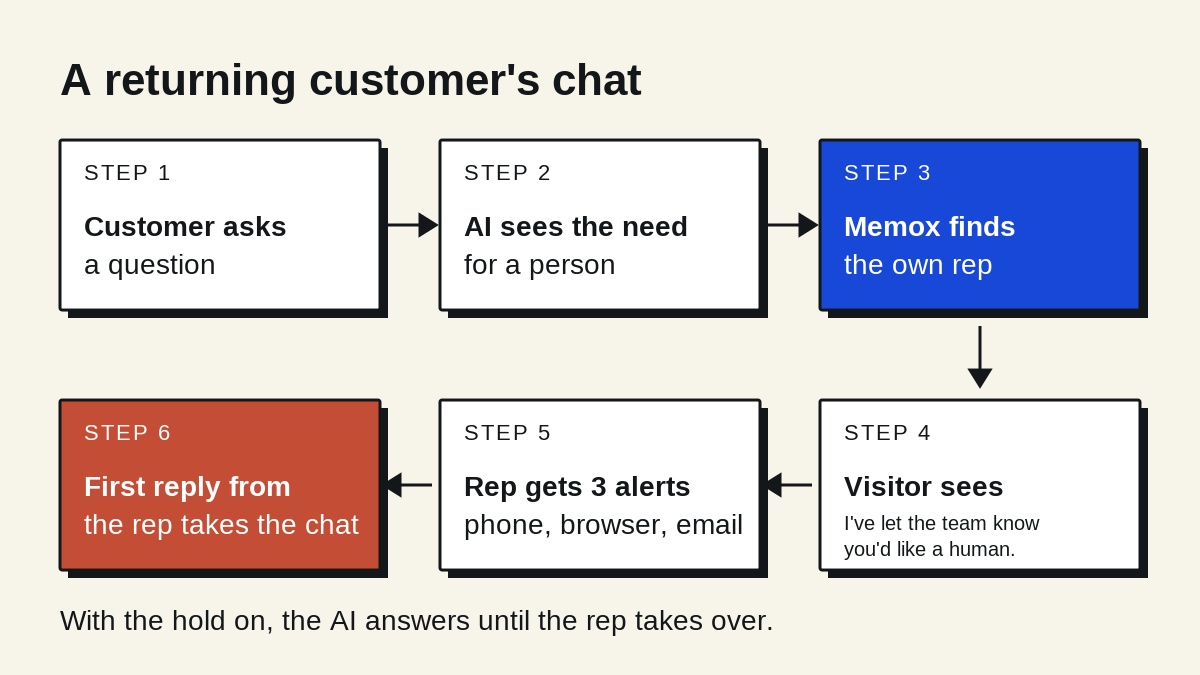
Memox answers your customers on your website and your phone line, and hands over to your team. A handoff is the moment the AI passes the chat to a person. Memox picks the person in a fixed order:
- The customer's own rep from the CRM.
- A free rep on the same team.
- The next free rep in turn.
Memox checks who is online on the web and who has the phone app. Then 3 things happen:
- The visitor sees "I've let the team know you'd like a human." The chat does not claim that a person is there before one replies.
- The rep gets a phone push, a browser push and an email with the visitor's name and contact details.
- The rep's first reply takes over the chat.
An owner or admin turns "receive handoffs" on or off for each team member. Turn it off for a person on leave.
What happens when the own salesperson is away?
You choose, with 1 setting for your company:
- Hold for the own rep. The chat waits for that person. The AI keeps answering until they take over. Choose this when most returning customers ask about money, delivery dates or a problem with an order.
- Pass to the team. A free rep on the same team gets the chat. Choose this when most questions are simple and speed matters more.
If your reps are often away for days, do not hold. A held chat then waits too long.
How to set up lead routing in 5 steps
- Name an owner for each customer. In your CRM, give each customer you care about 1 named salesperson. A customer without an owner goes to the free rep step.
- Connect your CRM. Memox syncs with HubSpot both ways. Our team sets up each connection with you, on a call, with your IT contact.
- Choose who receives handoffs. Turn the setting on only for people who take chats.
- Choose hold or pass. Use the test in the section above.
- Test with 1 real customer record. Ask for a person in the chat. Check that the right rep gets the alerts.
Then read the chat log each week. If the wrong person was asked, fix the owner in the CRM.
What ContainerOne saw
ContainerOne is an online container dealer. It uses the Memox website chatbot and the handoff to its reps. In use at ContainerOne since Aug 2025. 5,244 chat sessions to 27 Nov 2026. 553 were handed to a person. 543 of those had a rep assigned. Assigned means that the chat record names a rep. The number does not say what the rep did next, and the status line and alerts of today were added during this period. Read the ContainerOne case study for each number.
When this is not the right fit
- Memox connects to Outlook, Gmail, OneDrive, Shopify, HubSpot, Slack, Jira, GitHub and Google Chat. For another CRM, ask on the fit call.
- It hands the chat to a person. It does not promise how fast that person replies.
- It answers on website chat, phone and email. It does not answer text messages.
- It is not a help desk with ticketing.
Next step
If your customers get stuck with a bot and never reach their own rep, pick it for the free 30-day pilot. Our team sets up Memox on 1 real problem and runs it with you.
For the steps of the handoff itself, read how a chatbot human handoff works. To choose a tool, read how to choose a website chatbot with human handoff.
A data processing agreement (DPA / AVV) is available. Connects today: Outlook, Gmail, OneDrive, Shopify, HubSpot, Slack, Jira, GitHub, Google Chat. Where your data is kept and who can see it.
Frequently Asked Questions
What is lead routing?
Lead routing decides which person on your team gets each new enquiry. A simple rule gives it to whoever is free. A better rule checks your CRM first and sends a returning customer to their own salesperson.
What happens when the customer's own salesperson is away?
You choose. The chat can wait for that salesperson while the AI keeps answering. Or it passes to a free colleague on the same team.
What does the customer see while they wait?
The chat says "I've let the team know you'd like a human." It does not claim that a person is there before one replies.
How do I check that lead routing works?
Read the chat log each week. For each handoff, check that a person was assigned, that it was the right person, and that their first reply took over the chat.