AI for the Whole Team, or One Chat for Each Person?

Key Takeaways
- A personal AI chat is the right tool for one person's thinking.
- A team needs one brain when customers, phones and several people must get the same answer.
- 5 tests in 20 minutes show if your team has hit the limit of one chat per person.
- If you pass all 5 tests, a personal chat is enough. Save your money.
- A shared brain needs an owner and a monthly review, and your people still learn.
Three people on your team ask a personal AI chat the same question and get three different answers. A personal AI chat such as ChatGPT is the right tool for one person's thinking. A company needs one brain when customers, phones and several people must get the same answer. If you search for a ChatGPT alternative for business, you do not have to drop your personal chat. You add one shared layer on top of it.
This post is fair to personal AI chats. They are good at what they do. It shows the exact point where a team hits their limit, gives you 5 tests to run in 20 minutes, and tells you when to stay with what you have.
What personal AI chats do well
A personal chat is quick. You open it, ask a question, and get a draft, a summary, an idea or a plan. There is nothing to set up.
It is strong at four jobs:
- Writing and editing text, from an email to a proposal.
- Summarizing a long document that you paste in.
- Thinking a problem through, out loud, with a patient partner.
- Learning a new topic fast.
For one person with one task, it is hard to beat. One person who writes, edits and plans can get a lot of value from a personal chat. We say that plainly.

The picture above shows the shift. A personal chat is one person with one page. A team works on one sheet. The question is what happens when six people need the same facts.
Where a team hits the limit
The limit shows up when more than one person depends on the same facts. It has four causes.
Context is typed again
Say you have 8 people. Each one opens a personal chat. Each one types who the company is, what it sells, the price rules and the tone of voice. That takes minutes, every time, for every person.
Put numbers on it. Say each of your 8 people spends 5 minutes a day setting up context in a chat. That is 40 minutes a day for the team, and about 3 hours a week. The time is small for each person. Across the team it is a real cost, and it buys you nothing, because the next chat starts from zero again.
Answers differ
Each person explains the business a little differently. So each person gets a slightly different answer. The same question gets 3 answers on 3 screens, and nobody can say which one is right.
Nothing reaches the customer
A personal chat helps the person who types. It does not answer your website visitor at 2 am. It does not pick up your phone. It does not tell a rep that a customer needs a call back. A chat that only your staff can open cannot help your customers.
Knowledge leaves with the person
The best prompts, the corrections and the hard-won rules sit in one person's chat history. When that person is on leave, or leaves the company, the knowledge goes too. A new hire starts from zero.
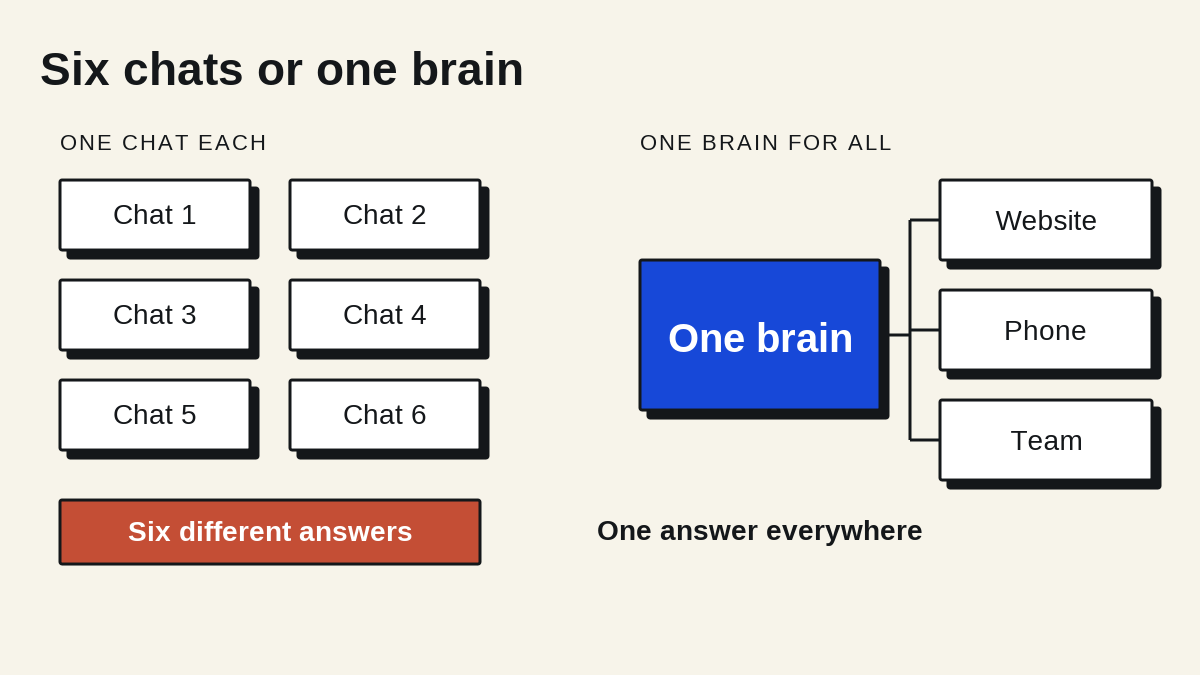
The diagram shows the difference. On the left, six people each hold their own chat and their own version of the facts. On the right, one brain holds the facts once. The website, the phone and the team all draw on it.
One chat per person versus AI for the whole team
Use this table to compare the two set-ups on the points that matter to a team.
| Point | One chat per person | AI for the whole team |
|---|---|---|
| Who holds the context | Each person, in their own chat | One shared brain for the company |
| Who gets the answer | The person who typed the question | Customers, callers and staff |
| A new hire | Starts from zero and asks colleagues | Asks the brain on day one |
| Customers and callers | Not reached | Answered day and night from your knowledge |
| Control | Each person decides what to paste in | Owner and admin set roles and keep the facts |
| Upkeep | Everyone fixes their own prompts | One owner updates the facts once |
The right column costs more to set up. It saves time once more than one person, or one customer, depends on the answer.
5 tests to run in 20 minutes
Do not decide from a blog post. Run these tests with the tools you use now. Then run the same tests with any tool you want to compare. Keep the questions the same.
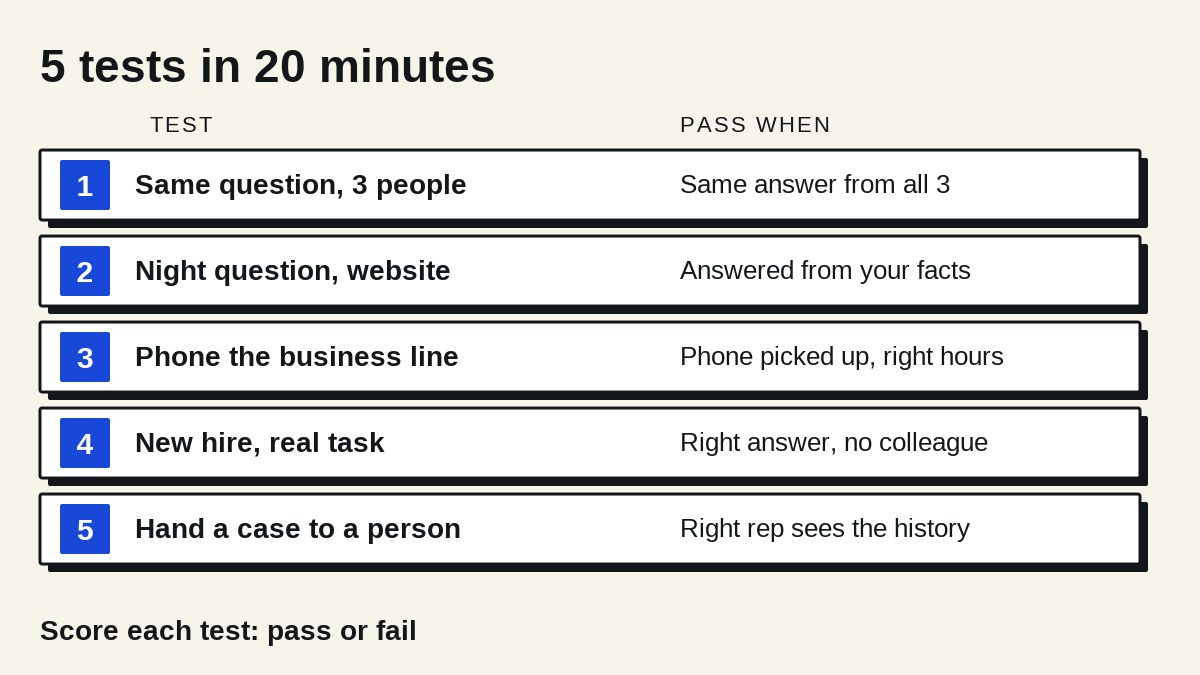
Test 1: Ask the same question to 3 people
Pick a real business question, for example "What is our rule for late payment?" Ask 3 people on your team to put it to the AI they use. Do not let them compare notes first.
Score a pass if all 3 get the same answer, and it matches your real rule. Score a fail if the answers differ.
Test 2: Send a customer question at night
Open your website at night, or on a weekend. Ask a question a customer would ask, such as the price of your most common product. Watch what happens.
Score a pass if something answers within seconds, from your own facts. Score a fail if nothing answers, or if the answer is general and wrong for your business.
Test 3: Phone your business line
Call your main number outside office hours. Ask for your opening hours and the price of one service.
Score a pass if something picks up, and gives the right hours and price. Score a fail if it rings out or goes to a mailbox.
Test 4: Give a new hire a real task
Take a person who started in the last few weeks, or ask a colleague to play one. Give them 10 minutes and one real task, for example "quote this customer". They may only use the AI.
Score a pass if they reach the right answer without asking a colleague. Score a fail if they have to interrupt someone.
Test 5: Hand a case to a person
Tell the AI that a customer needs a person. Watch where the case goes.
Score a pass if the right person is told, they see the customer's name and history, and the customer never hears a false promise. Score a fail if the case goes nowhere, or the person starts with a blank page.
Step by step: run the 5 tests with your team
One brain for your company.
It answers your customers, your phone and your team. Book a call: we answer your questions live, on your own website.
Block 20 minutes. Do these steps in order.
- Pick the tools to test. Use what your team uses now. Add one tool you want to compare.
- Write 5 real questions on a sheet. Take them from last week's emails and calls.
- Choose 3 people for test 1. Choose one new hire, or a colleague who plays one, for test 4.
- Run tests 1 to 5. Give each test about 4 minutes.
- Score each test pass or fail. Write one line on what you saw.
- Count the fails. Read the result with the guide below.
- Repeat the same tests with the second tool. Use the same people and the same questions.
How to read the result:
- 0 or 1 fail: a personal chat is enough. Keep it, and spend your time on training.
- 2 or 3 fails: your team has hit the limit. Look at the fails. If they are tests 2 and 3, you need something that talks to customers.
- 4 or 5 fails: your business knowledge lives in people's heads. A shared brain gives you the biggest gain.
The score tells you more than any feature list. Keep the sheet. You will run the same tests again after you change anything.
A score sheet you can copy
Use one row for each test. Write what you saw in plain words, not a grade.
| Test | Pass or fail | What you saw |
|---|---|---|
| 1. Same question, 3 people | Fail | Three late payment rules, one of them out of date |
| 2. Night question on the website | Fail | A contact form, no answer |
| 3. Phone after hours | Fail | Voicemail, full mailbox |
| 4. New hire, real task | Pass | Found the price list in shared files |
| 5. Hand a case to a person | Fail | Email sat in a shared inbox for a day |
This example sheet has 4 fails. Its owner would start with tests 2 and 3, because those fails cost customers. Tests 1 and 5 come next, because they cost trust inside the team.
Book a 30-minute call. We look at where your leads and customer questions come from today. We show Memox answering on your own website, live on the call. You leave with a plan: what we set up first and which of your tools we connect. Book the call
When a personal chat is enough
Be honest with yourself. A shared brain is not for every business. A personal chat is enough in three cases.
- You work alone. One person alone has one set of facts and no one to keep in line. Test 1 and test 4 do not apply.
- Each person does a different job. If your designer, your bookkeeper and your writer never need the same facts, there is nothing to share.
- Nobody calls or visits at night. If you have no website traffic out of hours and no phone line to cover, tests 2 and 3 do not apply.
In those cases, save your money. A personal chat does the job well.
Check again each time your team grows. A team of 3 people may pass every test. A company of 30 people, with a website and a phone, often does not. The tests tell you when you cross the line.
What a company brain adds
Most teams with customers and several staff fail test 2, test 3 or test 1. For them, a company brain adds what a personal chat cannot.
A company brain is one place that holds what your business knows: your knowledge, your team, your rules and your connected apps. The products work from it. For the full definition, read What is a company brain?
Memox is one brain for your company. It answers your customers, your phone and your team. Five products run on it: the website chatbot, the voice agent, the CRM, handoff to your team and the Memox app. For a tour of the app, read the Memox app: your own AI assistant.
Test 5 depends on the handoff. In a chat, the AI picks the customer's own rep from the CRM first. The visitor sees "A rep has been asked", and the rep gets a push and an email. The 4 steps are in human handoff from AI chat.
The Memox team sets up each connection hands-on with you. Memox connects to 11 apps, among them Gmail, Outlook mail, HubSpot, Slack and Shopify. See the platform page or the Universe for the whole picture.
Now map this to the tests. The chatbot passes test 2. The voice agent passes test 3. The shared knowledge helps tests 1 and 4. Handoff and the CRM pass test 5.
Worked examples: three companies run the tests
These companies are examples. They are not real customers.
A 140-person HVAC firm
Say the firm gets 40 calls a day. The office team uses personal chats to draft quotes. In test 1, three people ask about the call-out fee and get three answers. In test 3, the phone rings out after 6 pm. In test 5, a customer who wants a person has no one to go to.
Result: 4 fails. The firm puts its price rules and service areas into one brain. The voice agent picks up after hours. A rep is assigned when a caller needs a person. The next week, test 1 and test 3 pass.
A furniture retailer with 2 branches
Say each branch has its own delivery rules, and the staff paste them into chats by hand. In test 2, the website says nothing at night. In test 4, a new hire quotes the wrong delivery charge for the second branch.
Result: 3 fails. The shop writes both sets of delivery rules once, one for each branch. The website chatbot answers from them. The new hire asks the brain, and gets the right charge for the right branch.
A 90-person bookkeeping firm
Say each bookkeeper handles their own clients. No website chat is wanted, and clients call named people, not a main line. The managing partner runs the tests. Test 1 and test 4 do not apply, because nobody shares facts. Tests 2 and 3 do not apply either. Test 5 is a phone call to a named person.
Result: 0 fails that matter. The firm stays with personal chats, and spends its money on training. This is the right call.
Where is your data?
In Memox, your team shares one workspace with three roles: owner, admin and member. Each person keeps a private chat. Raw emails and file text stay private to the person who connected them.
Who keeps the knowledge current?
A shared brain is only as good as its facts. Facts go stale: a price changes, a policy changes, a product ends. Someone must own that.
Use a simple rule. Name one owner for each topic: prices, delivery, returns, opening hours, service areas. The owner updates the brain when the fact changes. Then hold a 30 minute review each month. Check the chat log and the call transcripts for questions the brain could not answer. Add the missing facts.
One update helps every place the brain is used: the chatbot, the phone line and the app. That is the gain over 8 chats, where the same fix has to be made 8 times.
It is still work. We do not say "set it up and forget it".
Your people still learn
Some leaders say: we want our people to learn AI, not hand it all to a system. Good. They should.
A shared brain does not stop learning. It changes what people learn. They learn to ask a clear question. They learn to check an answer against what they know. They learn to spot a gap in the knowledge and report it to the owner.
They no longer spend their time explaining the business to the AI again in each chat. That time goes to the work itself. Skill still matters, and a shared brain lets people use it on better problems.
Team plans of chat tools
Vendors of personal AI chats also sell team plans, and some tools search company files. They differ in what they share, what they connect to and whether they reach your customers and your phone. We do not list their features here. Check each vendor on its own site, then run the same 5 tests on it. The tests are the fair way to compare.
Moving over: a 2-week plan
You do not have to switch everything at once. Keep your personal chats while you move. This plan takes two weeks.
| Day | Action | Result |
|---|---|---|
| 1 | Run the 5 tests with your team | A score for your current set-up |
| 2 to 3 | List the 20 questions customers and staff ask most | A list of what the brain must know |
| 4 to 5 | Name an owner for each topic | One person for each set of facts |
| 6 to 8 | Add your knowledge. The Memox team sets up the connections you need with you | Your knowledge and apps in one place |
| 9 to 10 | Test the chatbot and the voice agent with your 20 questions | A list of gaps to fix |
| 11 to 12 | Fix the gaps and put the chatbot on your site | Customers get answers |
| 13 | Run the 5 tests again | A new score |
| 14 | Hold the first monthly review and set the date for the next | A habit that keeps the facts current |
Keep the sheet from day 1. The score on day 13 shows the change in numbers.
Common mistakes
- Deciding from a feature list. A list does not show how your team works. Run the 5 tests with real questions.
- Dropping personal chats on day one. People still need them for writing and thinking. Keep them, and add the shared brain.
- Loading everything in at once. A brain full of old files gives poor answers. Start with the 20 questions people ask most.
- No owner for the facts. Unowned facts go stale. Name one owner for each topic.
- Skipping the monthly review. Gaps stay hidden until a customer finds them. Hold the review and read the chat log.
- Testing only the staff side. Tests 2 and 3 are about your customers. Run them, even if your team is happy.
- Forgetting the human. Test 5 matters. Set up handoff so that a person is assigned when a customer asks for one.
Next step
Run the 5 tests with 3 people from your team and score each one pass or fail. The platform page and the universe show what a shared brain adds. To see how a case moves to a person, read website chatbot with human handoff.
Book a 30-minute call
- We look at where your leads and customer questions come from today.
- We show Memox answering on your own website, live on the call.
- You leave with a plan: what we set up first and which of your tools we connect.
If it fits, our team does the setup with you. We connect your tools, train the brain on your business and hand you a working system. You do not learn AI.
Each setup is hands-on, so we price it to your business. You get a clear quote after the call.
One brain for your company.
It answers your customers, your phone and your team. Book a call: we answer your questions live, on your own website.
Frequently Asked Questions
Memox is not a swap for a personal chat. It is one brain for the whole company, so your website, your phone and your team get the same answer. Many teams keep a personal chat too.
It is enough when each person does a different job and nobody needs the same answers. It falls short when several people, your website and your phone need one set of facts.
A personal chat serves the person who types. AI for the whole team holds your company knowledge once and answers customers, callers and staff from it.
Your team does. Name one owner for each topic and hold a 30 minute review each month. One update reaches the chatbot, the phone line and the Memox app.
Your data is hosted in Germany (EU). A data processing agreement (DPA / AVV) is available.
Yes. They learn to ask good questions and to check answers. They no longer explain the business again in each chat.
Run the same 5 tests with the same questions, the same people and the same 20 minutes on each tool. Score each test pass or fail.