An AI Voice Agent for Inbound Calls: What It Does on Your Phone Line

Key Takeaways
- An AI voice agent answers your business line in seconds, day and night, from your own knowledge.
- It answers from the same brain as your website chatbot, so a caller and a visitor hear the same answer.
- A call that needs a person goes to a follow-up list with a status, and your team works it each morning.
- Each call has a recording and a transcript, so 10 minutes a day is enough to review them.
- Test it with 5 calls before you go: call +1 (573) 490-0128, or call in your browser on the demo page.
A caller gets your voicemail at 6 pm, hangs up and rings the next firm on the list. An AI voice agent for inbound calls stops this. It is software that picks up your business phone in seconds, day and night, and talks with the caller in plain speech. It answers from your own knowledge and sends any call that needs a person to a follow-up list with a status. The Memox voice agent is one part of one brain: the same brain runs your website chatbot, your CRM and your team handoff.
This post shows what the agent does on a call, how your team works with it, and how to put one on your line. You can also call it now and judge it yourself.
What an AI voice agent does, in plain words
You may also see it called AI phone answering or an AI receptionist. The idea is the same. A call comes in. Software answers. The caller talks, and the software talks back.
A good one does 5 jobs:
- It picks up fast, with no menu to press through.
- It answers questions from facts your business owns.
- It takes the caller's name and need.
- It passes the call to a person when a person is needed.
- It leaves a record of the call that you can check.
The fifth job is the one most buyers forget. An agent you cannot check is an agent you cannot trust. So the recording, the transcript and the follow-up list matter as much as the voice.
An AI voice agent is not a phone menu. A menu asks the caller to press 1 for sales. An agent lets the caller say what they want.
A missed call is a lost lead
Think about why calls go unanswered. The reasons are plain, and they repeat every week.
- You are on a job site, in a meeting or with a customer.
- Your team is at lunch, or in the middle of a busy hour.
- The call comes after closing time, or before you open.
- Two calls arrive at once, and you can take only one.
The caller does not know any of this. The caller sees a ringing phone that nobody answers. A person with a problem or a purchase in mind does not wait. They try the next business on the list.
Voicemail does not fix this. Some callers leave a message. Many hang up. Even the ones who do leave a message wait hours for a call back, and by then they may have spoken to someone else.
The cost of a missed call is not the call. It is what the call was about: a quote, a booking, a repair, an order. One missed call can be the best lead of your week.

What happens in the first 10 seconds
The phone rings. The voice agent picks up in seconds. It greets the caller and asks how it can help.
Then the caller speaks, in their own words. They might say, "Do you do emergency call-outs on weekends?" or "I need a quote for a delivery." The agent listens and answers from your knowledge. It does not read a script. It looks up what your business has said about that topic.
Next it takes the caller's name and what they need. If the question is simple, the agent answers it and the call ends well. If the caller needs a person, the agent says so and records the request.
Diagram 1 shows the whole flow.
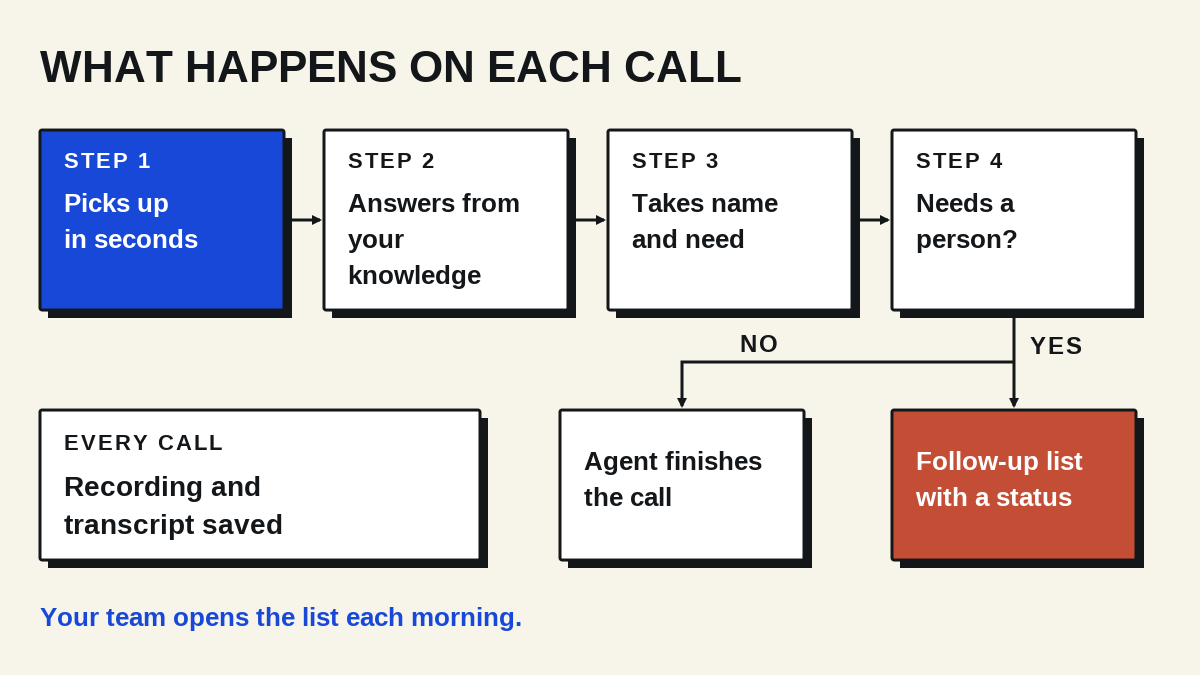
Notice what the agent does not do. It does not invent an answer when the knowledge has no answer. It can say it does not know, and offer a person. That behaviour is the difference between a helpful agent and a risky one.
What the agent answers from
The agent is only as good as what it knows. The Memox voice agent answers from your business knowledge: your website, your price rules, your policies and the answers your team already gives.
That means the work is not training a voice. The work is making sure your facts are right. If your Saturday hours changed last month, the knowledge must say so. If you no longer serve one town, the knowledge must say so.
Most businesses find that a small set of questions covers most calls. These are hours, location, services, rough prices and how to book. Get those right first. Add the rarer questions as you hear them in the call records.
It answers from the same brain as your website chatbot
Your business has one set of facts. The phone and the website should not tell two different stories.
The Memox voice agent and the website chatbot run on the same brain. You teach the business once. A visitor on your site and a caller on your line hear the same answer. Diagram 2 shows the idea.
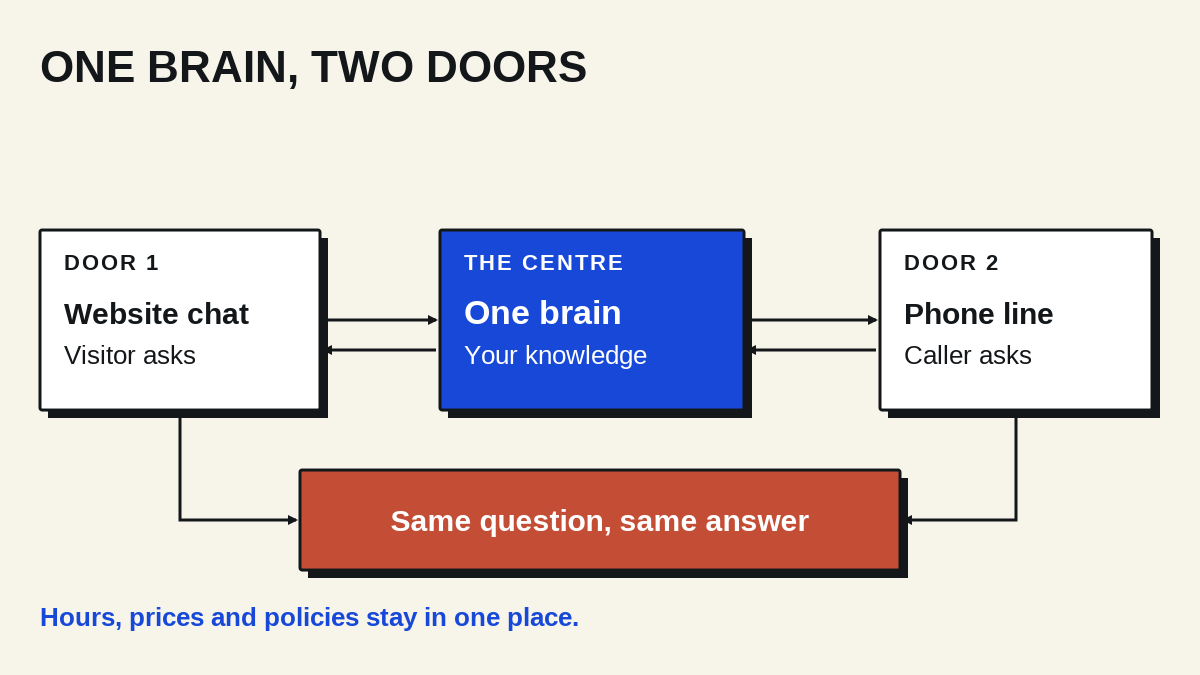
This matters more than it sounds. Without a shared brain, you keep one set of answers for the chat tool, another for the phone, and a third in your staff's heads. They drift apart. A customer who gets two answers stops trusting both.
With one brain, a change happens once. You fix the price rule in one place, and both doors use it. For the bigger picture, read what a company brain is.
When the caller needs a person
Some calls should reach a human. A complaint. A large order. A caller who wants the owner. A caller who is upset.
When a call needs a person, it goes to a follow-up list. Each item has a status, so your team can see what is open and what is done. Nobody has to guess who called back.
Each call also has a recording and a transcript. The person who calls back reads them first and does not start cold. The caller has already told the story once. They should not have to tell it again.
This is the phone side of handoff to your team. On the web, the handoff picks a rep and sends a push. On the phone, the call lands on the list. For the web side in detail, read human handoff from AI chat.
How a team works the list each morning
A list only helps if somebody owns it. Here is a simple routine.
- One named person opens the list at the start of the day.
- They call the most urgent callers first.
- They read the transcript before each call, so they know the story.
- They change the status when they finish.
- They note any question the agent could not answer, so the knowledge improves.
That last step is how the agent gets better. Every call it could not handle is a lesson for the knowledge.
Every call becomes a contact
The call does not end when the caller hangs up. In the CRM, every call becomes a contact with a stage and a timeline. Nobody types it in.
So a 9 pm call is a contact with a timeline by the next morning. Your team sees who called and what they asked. The CRM also records which rep owns each customer. For more on this, read the CRM that fills itself.
One brain for your company.
It answers your customers, your phone and your team. Book a call: we answer your questions live, on your own website.
Recordings and transcripts: review calls in 10 minutes a day
You can hear and read each call. That is how you keep control without sitting by the phone.
A small daily routine is enough. Set a timer for 10 minutes.
- Open the list of yesterday's calls.
- Read the transcripts of 3 calls: one that went well, one that needed a person, one that was short.
- Play the recording of any call that looks odd.
- Write down each wrong or missing answer.
- Fix the knowledge, and move on.
After a week, you know your callers. You also know which questions your website never answered. Many owners find that the call record shows gaps in their own website text.
Do not review every call forever. Review all calls in the first 2 weeks. Then review a few each day. If the agent gets a topic wrong twice, fix that topic the same day.
Numbers, and calling out
You have two choices for the number. You can get a new number for the voice agent. Or you can port your own number, so callers keep dialing the number they already know.
A new number suits a new line, such as an after-hours line or a line for one campaign. A ported number suits a business whose number is on its vans, its cards and its old invoices.
The agent can also call out. It can call your list, with do-not-call checks and legal calling hours. That means it skips numbers that should not be called, and it calls only in the hours the law allows. Use it for follow-ups, reminders and lists that you have the right to call.
Book a 30-minute call. We look at where your leads and customer questions come from today. We show Memox answering on your own website, live on the call. You leave with a plan: what we set up first and which of your tools we connect. Book the call
Voice agent, voicemail, answering service or receptionist
These four are different tools. Here is how they compare in plain categories.
| Voicemail | Answering service | Receptionist | AI voice agent | |
|---|---|---|---|---|
| Who answers | A recording | A person at an outside firm | A person on your staff | Software |
| Hours | All hours, but nobody speaks | Often long hours | Office hours | Day and night |
| What it knows | Nothing | A script and a few notes | Your business, in depth | Your knowledge base |
| Can it answer a question | No | Only simple ones | Yes | Yes, from your knowledge |
| After the call | A message to play | A message or a note | Whatever the person does | Recording, transcript, follow-up list |
Each has a place. A good receptionist is best for a complex call that needs judgment. Voicemail is fine for a line that few people call. An answering service helps when you need a person at odd hours and your calls are simple.
The voice agent shines where calls are many, questions repeat and hours are long. It also pairs with a person. The agent takes the first call, and your receptionist takes the calls that need a human. For a closer look at why speed matters so much on a call, read the 2.5 second problem.
How much does an AI receptionist cost
No honest article can give you one number, because cost depends on your line. Four things drive it:
- How many calls you take in a month.
- How long the average call lasts.
- How much the agent must know, and how much set-up that takes.
- Whether you need a new number, a ported number or outbound calling.
Do not compare a monthly fee alone. Compare what you get after the call: a recording, a transcript, a follow-up list and a contact in your CRM. Before you talk to any vendor, write down your rough monthly call count and your average call length. Then book a call with the Memox team on the demo page.
Put a voice agent on your line: step by step
This plan takes a focused day, plus a few days of test calls.
- Pick the line. Decide which number the agent will answer: a new number, or your own number ported.
- List the top 10 call reasons. Look at your last 2 weeks of calls and voicemails. Write the 10 most common reasons people call. Hours, price, booking and location usually lead.
- Check the knowledge. For each reason, write the right answer in one or two sentences. Check that your website and price rules say the same thing.
- Decide when a person is needed. Write a short list: complaints, large orders, urgent faults, anyone who asks for the owner. These calls go to the follow-up list.
- Set who works the follow-up list. Name one person and a backup. Pick the time of day when they open the list.
- Test with 5 calls. Call the agent yourself, and ask a colleague to call. Ask easy questions, a hard question, a question outside your knowledge, a request for a person and a rude caller. Read each transcript.
- Go. Turn the agent on for your line. Review all calls for 2 weeks, then a few each day.
You can run steps 2 to 5 without any tool. They are the same list you would write for a new hire at the front desk.
Three worked examples
These are invented businesses, to show how the agent fits in. The numbers are examples.
A plumbing firm on the road
Say a plumbing firm has 40 technicians on jobs all day and a small office team. Calls go to voicemail from 8 am to 5 pm.
A caller rings at 11 am. The agent picks up and the caller says, "My kitchen tap is leaking and I need someone today." The agent knows the firm's service area and its same-day rule. It confirms the caller is inside the area, takes the name, the address and the problem, and says a person will call back. The call goes to the follow-up list.
The dispatcher opens the follow-up list at 1 pm, reads the transcript and calls the caller back in 2 minutes. The caller had not rung anyone else.
A clinic front desk at lunch
Say a clinic group has 6 people at its front desks. They go to lunch at 1 pm, and the phone rings.
A caller asks, "What are your hours on Friday, and do I need a referral?" The agent answers both from the clinic's knowledge. The caller then asks to move an appointment. The agent does not change the schedule, because that needs a person. It takes the name and the new time the caller wants, and puts it on the follow-up list.
When the desk returns, a staff member works through the list. The calls about hours are already answered. The staff spend their time on the calls that need a decision.
An equipment rental yard after hours
Say a rental yard closes at 5 pm, but contractors plan their week in the evening.
At 7 pm a contractor calls and asks, "Do you have a 3-tonne excavator for Monday, and what is the daily rate rule?" The agent answers from the yard's price rules and says how bookings work. The contractor asks for a delivery on Sunday. That is outside the yard's rules, so the agent says it needs a person. The call goes to the follow-up list.
At 8 am the next day, the yard manager opens the list. The contractor's call is first, with the recording and transcript. The manager calls, agrees the delivery and updates the status. The booking is not lost to a rival yard that picked up at 7 pm.
What to ask before you choose any voice agent
Use this table when you compare options. A good agent should give a clear answer to each one.
| Question | Why it matters | What a good answer looks like |
|---|---|---|
| What does it answer from? | Wrong facts do harm | Your own knowledge, not generic text |
| What happens when it does not know? | Bluffing loses trust | It says so and offers a person |
| Can I hear every call? | You need to check it | A recording and a transcript for each call |
| Where does a call go when a person is needed? | A call must not vanish | A follow-up list with a status |
| Does the call reach my CRM? | Calls are leads | Each call becomes a contact |
| Can I keep my number? | Callers know it | A new number or a port |
| Who sets it up? | Set-up decides the result | The vendor helps hands-on |
| Can I try it first? | You should hear it | A phone number or a web call to test |
Where this fits in Memox
Memox is one brain for your company. It answers your customers, your phone and your team. The voice agent is the phone part.
The same brain runs the website chatbot, the CRM, handoff to your team and the Memox app, your own AI assistant for the work itself. Every chat and every call becomes a contact in the CRM. Nobody types it in.
Memox connects to the tools your team already uses, and the Memox team sets each connection up hands-on with you.
If you want the full picture, see the voice agent page, the platform and the universe.
Common mistakes
- Turning the agent on before the knowledge is right. The agent repeats your errors at speed. Fix: write and check the top 10 answers first, then test.
- Skipping the test calls. You find the weak spots in front of real customers. Fix: make 5 calls yourself before you go.
- No owner for the follow-up list. The list grows, and callers wait. Fix: name one person and a backup, and set a time to open the list.
- Never reading the transcripts. Small errors repeat for weeks. Fix: spend 10 minutes a day on 3 calls.
- Making the agent answer everything. Some calls need a person. Fix: write the list of calls that go to a human, and keep it short and clear.
- Keeping two sets of answers. The phone says one thing and the website says another. Fix: use one brain for both, and change facts in one place.
- Judging by price alone. A cheap tool with no recording or list costs you in lost calls. Fix: compare what you get after each call.
Test it now
Call +1 (573) 490-0128, or open the demo page and call in your browser. Ask what your own customers ask. Then ask for a person, and see what the agent does.
Book a 30-minute call
- We look at where your leads and customer questions come from today.
- We show Memox answering on your own website, live on the call.
- You leave with a plan: what we set up first and which of your tools we connect.
If it fits, our team does the setup with you. We connect your tools, train the brain on your business and hand you a working system. You do not learn AI.
Each setup is hands-on, so we price it to your business. You get a clear quote after the call.
One brain for your company.
It answers your customers, your phone and your team. Book a call: we answer your questions live, on your own website.
Frequently Asked Questions
An AI voice agent is software that answers a phone call and talks with the caller in plain speech. The Memox voice agent answers from your business knowledge, takes the caller's details and sends a call that needs a person to a follow-up list.
It picks up your business line in seconds, greets the caller and answers from your knowledge. It takes the caller's name and need. If the caller needs a person, the call goes to a follow-up list with a status.
The best one answers correctly from your own knowledge and shows you every call. Test any voice agent with 5 real calls, and check what you get after each call.
Cost depends on how many calls you take, how long they last and how much the agent must know. Compare what you get after each call, not only the monthly fee.
Yes. You get a new number for the voice agent, or you port your own, so callers keep dialing the number they know.
Yes. Each call has a recording and a transcript, so you can hear and read what the agent said.
Yes. It can call your list, with do-not-call checks and legal calling hours.