AI Assistant for Business: One for Each Person, or One for the Team?

Key Takeaways
- A personal AI assistant knows only what its owner tells it, so 3 people can get 3 different answers.
- A team assistant starts from shared business knowledge, so the same question gets the same answer.
- Choose a personal assistant for solo work. Choose a team assistant when several people ask the same business questions.
- A team assistant still keeps a private chat for each person, and raw emails and file text stay private.
- You can move from personal chats to a team assistant in 1 week.
Two people on your team ask their own AI chat the same customer question. They get two different answers, and one goes to the customer. The fix depends on your team size. Choose a personal AI chat if you work alone. Choose one shared assistant if 3 or more people ask the same business questions. That is the whole rule for an AI assistant for business.
The reason is simple. A personal chat knows only what its owner has told it. A shared assistant starts from facts that belong to the company. When the facts are shared, the answers match.
The rest of this post shows how to tell which one you need. It has a table, a short test and 3 examples. It also has a decision tree and a 1-week plan to move your team.
What an AI assistant does in a work day
An assistant for business does a few jobs. Most days, a person uses it for 5 of them.
- Answer questions. "What do we charge for a rush order?" "Which day do we close in December?"
- Draft. A reply to a customer, a quote, a note to a supplier.
- Find. The mail from last week, the file with the price list, the order from a customer.
- Remind. A morning check-in with what is due today. A routine that runs every Monday.
- Hand over. "Ask Hana to check the stock for the Friday order." The task goes to a named person.
A personal chat is good at jobs 2 and 3 when the owner pastes the material in. It is weaker at jobs 1 and 5. Job 1 needs company facts. Job 5 needs more than one person.
That gap is the whole topic of this post. The question is not "which AI is smartest". The question is "who owns the facts, and who can see the tasks".

The two models
There are two ways to give AI to a team.
One for each person. Each person opens a personal AI chat, such as ChatGPT or a similar tool. The chat belongs to that person. It remembers what that person says. It helps with that person's work.
One for the team. The business has one assistant. It learns the business once. Each person uses it from their own account, with their own private chat. The facts come from the company. The tasks can pass from person to person.
Both models use the same kind of AI underneath. The difference is where the knowledge lives and who can see the work.
The comparison table
| One for each person | One for the team | |
|---|---|---|
| Context | Whatever that person pasted in | Facts the business gave once |
| Consistency | Each chat can answer differently | Same facts, same answer |
| Set-up effort | Small for each person, repeated n times | One set-up for everyone |
| New hire's first day | Empty chat | Starts with the business knowledge |
| Control | The owner cannot see what each chat knows | 3 roles: owner, admin and member |
| Cost of a wrong answer | Falls on a customer or a deal | Lower, because answers share one source |
| Shared tasks | Not built in | A task goes to a named person |
| Best for | Solo writing and research | Questions and tasks the team shares |
Read the table by row, not by column. If one row hurts, look at that row first. Many owners feel the "new hire" row and the "wrong answer" row the most.
The problem: 3 people, 3 answers
Picture a customer who asks for a refund on an order that arrived late.
Ali is in sales. He asks his AI chat. It does not know your refund rule, so it gives a general answer. Noor is in support. She pasted your policy into her chat last month, so her AI gives a good answer. Bilal is new. He asks and gets an answer that sounds sure and is wrong.
The customer gets 3 different replies. Nobody is lazy. Nobody is wrong to use AI. Each chat knows only what its owner told it.
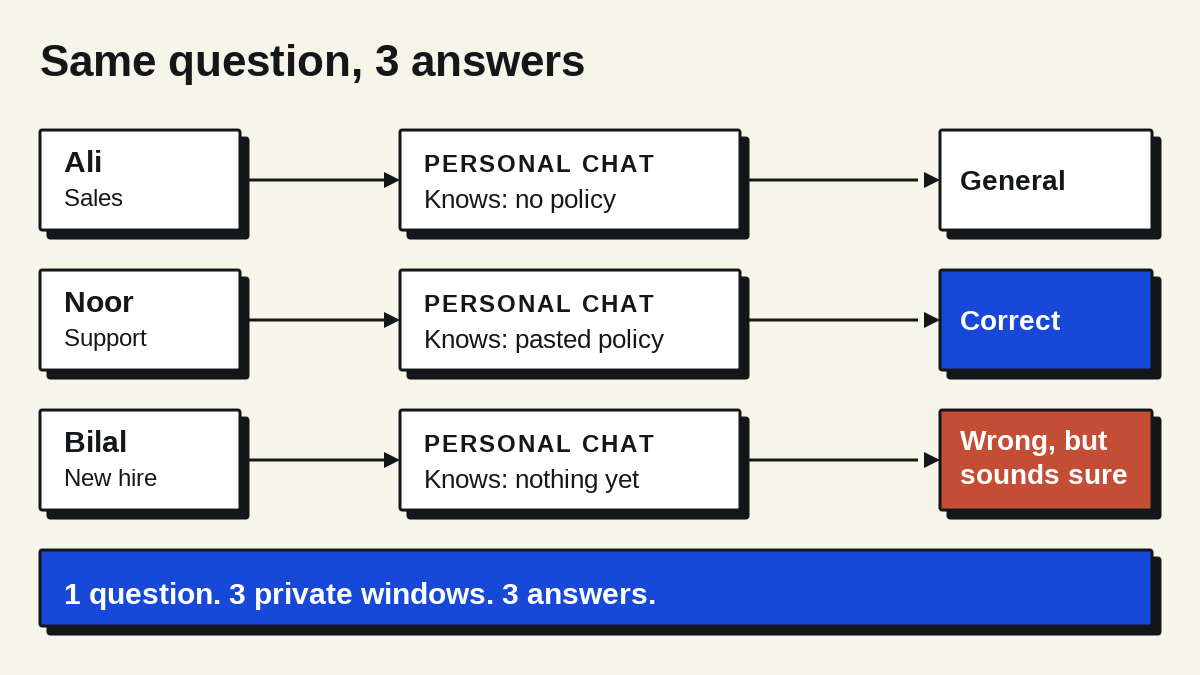
This is the limit of the personal chat. It is only as good as the context in one person's window. And you cannot see that context. You cannot check it. You cannot fix it for all 3 people at once.
A tone difference is fine. A fact difference is not. A friendly reply and a formal reply can both be right. A refund of 14 days and a refund of 30 days cannot both be right.
What "shared knowledge" means in plain words
Shared knowledge is the set of facts that any good employee in your company would know. What you sell. What it costs. How you treat a late order. Who handles what.
You do not write a manual to get there. In the Memox app, you type your website. The app reads it and learns what your business does in about 1 minute. Then you invite your team. Each person gets the same business knowledge.
When a fact changes, you correct it once, and everyone gets the new answer. For a step-by-step set-up of the knowledge itself, read AI knowledge management for a team. This post stays on the choice.
What stays private
A shared assistant does not mean a shared inbox. Memox keeps three things apart.
- Roles. There are 3: owner, admin and member.
- A private chat for each person. Your questions and drafts are yours.
- Raw emails and file text. They stay private to the person who connected them.
So Bilal does not read Noor's mail. He gets the refund rule from the shared knowledge. The rule is shared. The mail is not.
Three companies, three verdicts
Here are 3 invented businesses. None is a real company.
A 24-person design studio
Twenty-four designers work on separate client projects. Each one writes their own briefs, does their own research and sends their own mail. They rarely answer the same question twice. The studio has no price list that changes, and no policy that a customer can ask about.
Verdict: personal assistants are enough. Each designer gets better output from a chat that knows their own style. A shared assistant adds little here. If the studio starts to sell packages with fixed prices, look again.
A 120-person HVAC firm
One brain for your company.
It answers your customers, your phone and your team. Book a call: we answer your questions live, on your own website.
The firm has 10 dispatchers, 90 technicians and 20 people in the office. Customers call, write and use the website form. The same 20 questions come up every week: call-out fees, service areas, warranty on a part, how to book a visit. The dispatchers give slightly different answers. A technician quotes an old fee to a customer.
Verdict: a team assistant. The questions repeat. A wrong fee costs money and trust. When a dispatcher says "ask Hana to confirm the part is in stock", the task should have a name on it and a board that shows it. That is a team job.
A furniture shop with 2 branches
Each branch has 30 people. They sell the same range, but stock and delivery days differ by branch. Staff turn over twice a year. Each new person asks the same set of questions in the first month.
Verdict: a team assistant. The shared facts are the range, the prices and the delivery rules. The branch details are part of the same knowledge. A new hire asks the assistant on day 1 and gets the shop's answer, not a guess.
| Business | Same questions repeat? | Wrong answer costs? | Tasks pass between people? | Verdict |
|---|---|---|---|---|
| Design studio, 24 people | No | Low | Rarely | Personal |
| HVAC firm, 120 people | Yes, weekly | High | Yes | Team |
| Furniture shop, 2 branches | Yes, for each new hire | Medium | Yes | Team |
A decision tree with 4 questions
Use this when you are not sure. Answer the questions in order. Stop when you reach a box.
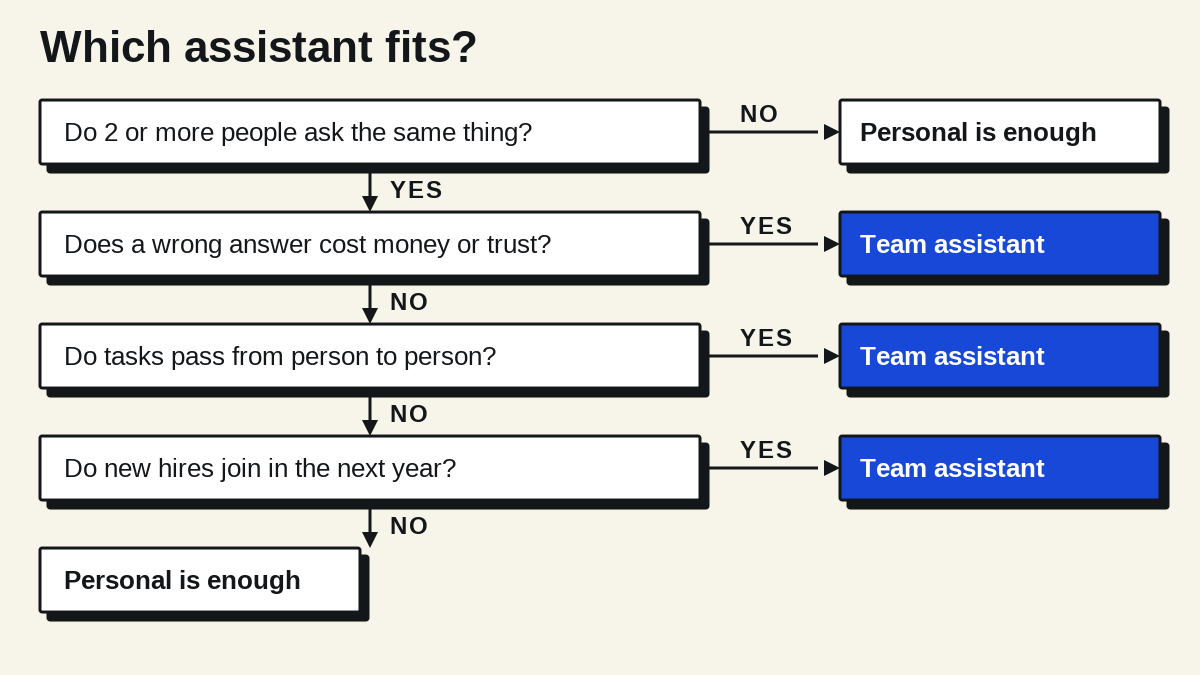
The questions work because each one maps to a row in the table.
- Do 2 or more people ask the same thing? If no, the chat has no shared facts to protect. Personal is enough.
- Does a wrong answer cost money or trust? If yes, you want one source of facts that you can fix once.
- Do tasks pass from person to person? If yes, you need a place where a task has a name on it.
- Do new hires join in the next year? If yes, you want day 1 to start with the business knowledge, not an empty chat.
One yes from questions 2, 3 or 4 is enough to test a team assistant. Four noes mean you can stay with personal chats and save the effort.
Book a 30-minute call. We look at where your leads and customer questions come from today. We show Memox answering on your own website, live on the call. You leave with a plan: what we set up first and which of your tools we connect. Book the call
The hidden cost of one chat for each person
The cost of a personal chat does not show on a bill. It shows in minutes, in repeats and in answers that differ. You can reason about it with a small example.
Say a team has 10 people. Each person uses a personal chat. Each one spends 15 minutes a week pasting the same price rules and policies into the chat, so that it can answer well. That is 10 times 15, or 150 minutes a week. It is 2.5 hours of the team's time. This is an example. Your numbers will differ. Count your own.
Now add a new hire. In a personal chat, the new person starts empty. Say they need 3 hours to build up a chat that knows the business. A team assistant starts with the facts, so those hours go to the real work.
There is a third cost that has no number in the example. It is the answer that differs in front of a customer. One wrong refund promise can cost more than a month of the time above. You cannot count it in advance. You can only reduce the chance.
Three places the cost hides
- Re-explaining. Each person tells their chat the same facts. Each one tells it a little differently.
- Onboarding. A new hire asks colleagues, who stop their own work to answer.
- Drift. A policy changes on Monday. Two chats learn it. Three do not.
None of these is a failure of the AI. They are what happens when the facts are spread across many private windows.
What a team assistant looks like in use
Here is a normal day with the Memox app on a phone or on the web.
In the morning, the app runs your check-in. It answers from your mail, calendar, files and store. Memox connects to 11 apps: Outlook mail, Outlook Calendar, OneDrive, Gmail, other email, Shopify, GitHub, Jira, HubSpot, Slack and Google Chat. The Memox team sets each connection up hands-on with you.
A customer writes in. You ask the app to draft a reply. It drafts the reply. You read it and approve it. The app does not send on its own. Every email and every invite waits for your yes.
Then you hand a task to a teammate. Your teammate gets a push. A board shows who has what. Nobody has to ask "did anyone do the stock check?"
Move from personal chats to a team assistant in 1 week
This plan suits a team of 3 to 15 people. Each step takes about 30 minutes, apart from the test.
- Day 1: Type your website. The owner opens the Memox app and types the website address. The app reads the site and learns what the business does in about 1 minute. Read the result and fix what is wrong.
- Day 1: Ask 10 real questions. Take the 10 questions your team asked last week. Ask them in the app. Mark each answer as right or wrong against your real policy.
- Day 2: Invite the team. Add each person. Choose the role: owner, admin or member. Most people are members.
- Day 2: Connect the owner's apps. The Memox team sets up the connections with you, for example Gmail or Outlook, and your store if you have one.
- Day 3: Explain approvals. Tell the team that every email and every invite is approved by the person before it goes. The app drafts. People decide.
- Day 4: Hand over 3 real tasks. Give one task to each of 3 teammates from the app. Check that each person got the push and that the board shows the task.
- Day 5: Stop pasting. Ask the team to stop pasting policies into personal chats. If an answer is wrong, they tell the person who owns that topic, who corrects the fact once.
- Day 7: Compare. Ask the same 10 questions again. Count right answers. Count the minutes each person spent explaining the business this week. Compare with last week.
You can keep personal chats for solo work. This is not an either-or. It is a change of where company facts live.
If your team says it is too busy to start, read Too busy to learn AI?. It shows the smallest first step.
A table for the week
| Day | Who | Action | Done when |
|---|---|---|---|
| 1 | Owner | Type the website, ask 10 questions | You know the right and wrong answers |
| 2 | Owner | Invite the team, set roles | Each person has an account |
| 2 | Memox team and owner | Connect the first apps | Mail or store answers work |
| 3 | Owner | Explain approvals | Team knows it approves each send |
| 4 | Owner and team | Hand 3 tasks | The board shows 3 tasks with names |
| 5 | Topic owners | Correct wrong facts once | The same question gets the right answer |
| 7 | Owner | Repeat the 10 questions | Right answers rise |
Where Memox fits
Memox is one brain for the company. The Memox app is the part your team uses for the work itself. The same brain also runs other parts, so what you teach once reaches your customers and your phone.
- The website chatbot answers visitors day and night from the same knowledge.
- The voice agent picks up the business line in seconds and answers from the same knowledge.
- The CRM turns every chat and every call into a contact with a stage and a timeline. Nobody types it in.
- Handoff sends a chat to the right rep when a visitor needs a person. It picks the customer's own rep from the CRM first.
- The Memox app is your team's own AI assistant.
This is the master line: one brain for your company. It answers your customers, your phone and your team.
A personal chat cannot do this, because it has no shared brain to build on. It stays inside one person's window. To see how the parts connect, visit the platform page and the Universe page. To see how fast a business can be set up from its website, read URL to AI agent in two minutes.
One proof point
ContainerOne is an online container dealer. It uses the Memox website chatbot. In the 30 weeks to 27 Apr 2026, it had 797 chats and 734 leads. The AI alone handled 90.6% of the chats. There were 75 handoffs, and a rep was assigned to each one. The customer approved these numbers.
That case is about the website chatbot, not the Memox app. It shows what the brain does when it answers from one business's own knowledge.
Common mistakes
- Choosing by the cleverest AI. The model matters less than what it knows about your business. Fix: ask each tool 10 questions about your own business, not general ones.
- Letting each person build their own context. You get 10 versions of your refund policy. Fix: keep company facts in one place and let people keep personal style in their private chat.
- Sharing everything. A team assistant should not expose private mail. Fix: keep roles clear, keep a private chat per person, and keep raw emails and file text with the person who connected them.
- Trusting an answer that sounds sure. A confident answer can be wrong. Fix: test with questions where you know the right answer, and fix the fact when an answer is wrong.
- Letting AI send without a check. A wrong email goes to a real customer. Fix: approve each email and each invite before it goes.
- Skipping the owner for tasks. A task with no name is a task nobody does. Fix: hand each task to a named teammate and use the board.
- Waiting for a perfect set-up. The team never starts. Fix: start with 10 questions and 1 week. Improve from the wrong answers.
Next step
Write down the 10 questions your team asked last week. Ask 3 people to answer them with their own AI chat. Count how many answers match your real policy. To see the team model in use, open the Memox app page.
Book a 30-minute call
- We look at where your leads and customer questions come from today.
- We show Memox answering on your own website, live on the call.
- You leave with a plan: what we set up first and which of your tools we connect.
If it fits, our team does the setup with you. We connect your tools, train the brain on your business and hand you a working system. You do not learn AI.
Each setup is hands-on, so we price it to your business. You get a clear quote after the call.
One brain for your company.
It answers your customers, your phone and your team. Book a call: we answer your questions live, on your own website.
Frequently Asked Questions
It is an AI that helps with work: it answers questions, drafts emails, finds files and keeps tasks moving. Some are built for one person. Some are built for a whole team.
The best one is the one that knows your business. If you work alone, a personal AI chat is enough. If 3 or more people ask the same business questions, pick an assistant that the whole team shares.
It depends on the job. For solo writing or research, a personal assistant is enough. For questions about your business that several people ask, a team assistant gives each person the same answer.
Yes. In Memox each person keeps a private chat, and there are 3 roles: owner, admin and member. Raw emails and file text stay private to the person who connected them.
No. In Memox the business is set up once, and the team asks in plain words.
A team can do it in 1 week. Day 1 is the website and the account owner. Days 2 to 5 are the team, the approvals and the first handed tasks.
In the Memox app it does not. It drafts the reply, and you approve each email and each invite before it goes.