Expand North Star 2026: What to Ask an AI Company at the Stand

Key Takeaways
- Ask every AI company the same 8 questions: what it does, which channels, what it does when it does not know, where your data is, who takes over, who supports you, what it costs, who else uses it.
- Plan 20 minutes for each stand: 2 minutes for your problem, 8 to see it work on your business, 5 for the 8 questions, 5 for the next step.
- A good stand demo works on your own input and shows a person taking over. A weak demo is a video.
- Memox is at stand H43-R54, 8 to 10 Dec 2026. Call the voice agent demo line, type your website into the Memox app, and ask us to show a handoff.
- Ask every vendor, including Memox, for the same plain answers in writing.
You walk the hall at Expand North Star 2026, and every AI stand says the same thing in a new voice. Ask every one of the AI companies in Dubai the same 8 questions. Memox is at stand H43-R54, 8 to 10 Dec 2026. This guide gives you the 8 questions, a 20-minute plan for each stand and our own answers.
One brain for your company. It answers your customers, your phone and your team.
The 8 questions in one list
Write these on one page. Ask them at every stand.
- What does it do, and what does it not do?
- Which channels does it cover: website, phone, email?
- What does it do when it does not know?
- Where is my data hosted?
- Can a person take over, and what does the customer see?
- Who supports me after the show?
- What does it cost, on paper?
- Who else uses it, with a result I can check?
Memox is at stand H43-R54. Our answers to all 8 are further down this page.
Expand North Star 2026 in 3 lines
Expand North Star (GITEX) is in Dubai.
It runs 8 to 10 Dec 2026.
Memox is at stand H43-R54. Note the stand number before day 1.
Many stands use the word "AI". Your job is to tell them apart in a short, fair test.

How to plan a stand visit: 20 minutes
Pick 3 stands before you go. Give each 20 minutes. Walk past the rest.
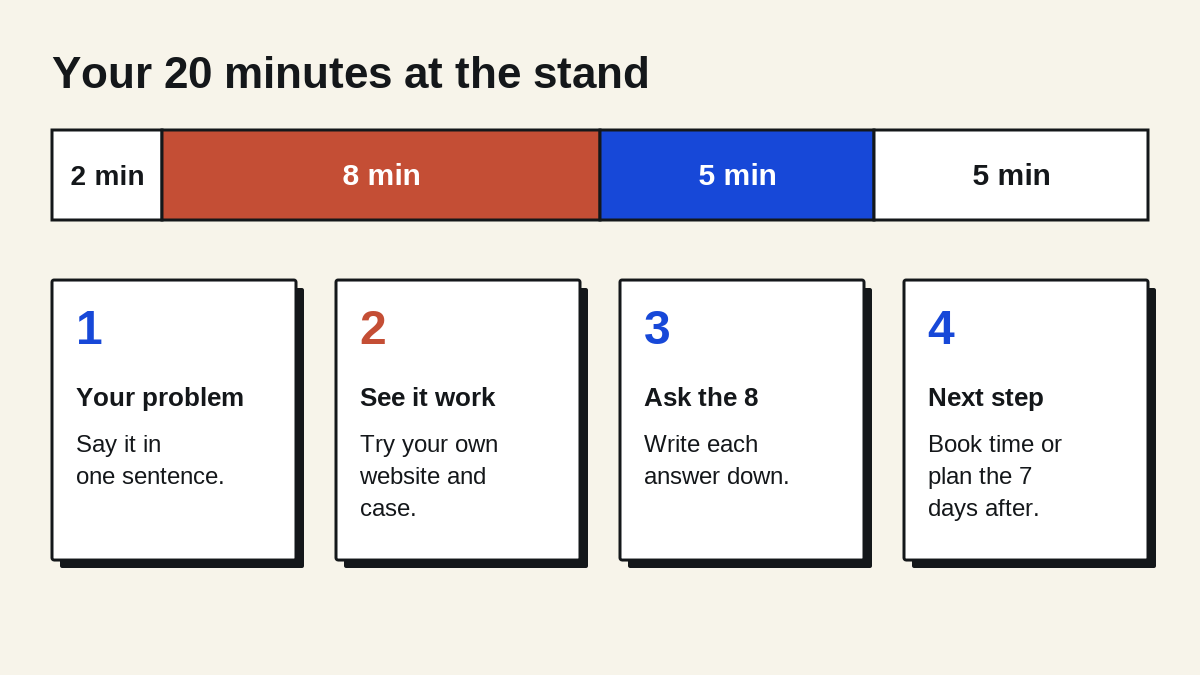
The plan has 4 blocks. The diagram shows the time for each block.
Block 1: your problem (2 minutes)
Say your problem in one sentence. Name the work, not the tool. For example: "Our phone rings after hours and nobody answers." Or: "My team answers the same 30 questions every week."
A good stand team listens first. A weak stand team starts a slide show.
Block 2: see it work on your business (8 minutes)
This is the longest block. Ask the team to use your input. Give them your website address. Ask a question your customers ask. Ask for a call to be made, or make the call yourself.
Do not accept a fixed script. It proves the demo works for the vendor, not for you.
Block 3: the 8 questions (5 minutes)
Ask the 8 questions in the order below. Write each answer in one line. If the answer is vague, ask once more, then move on.
Block 4: the next step (5 minutes)
Ask what happens next. Ask for a named contact, a price on paper and a date. If you like the product, book a follow-up.
The 8 questions to ask AI companies in Dubai
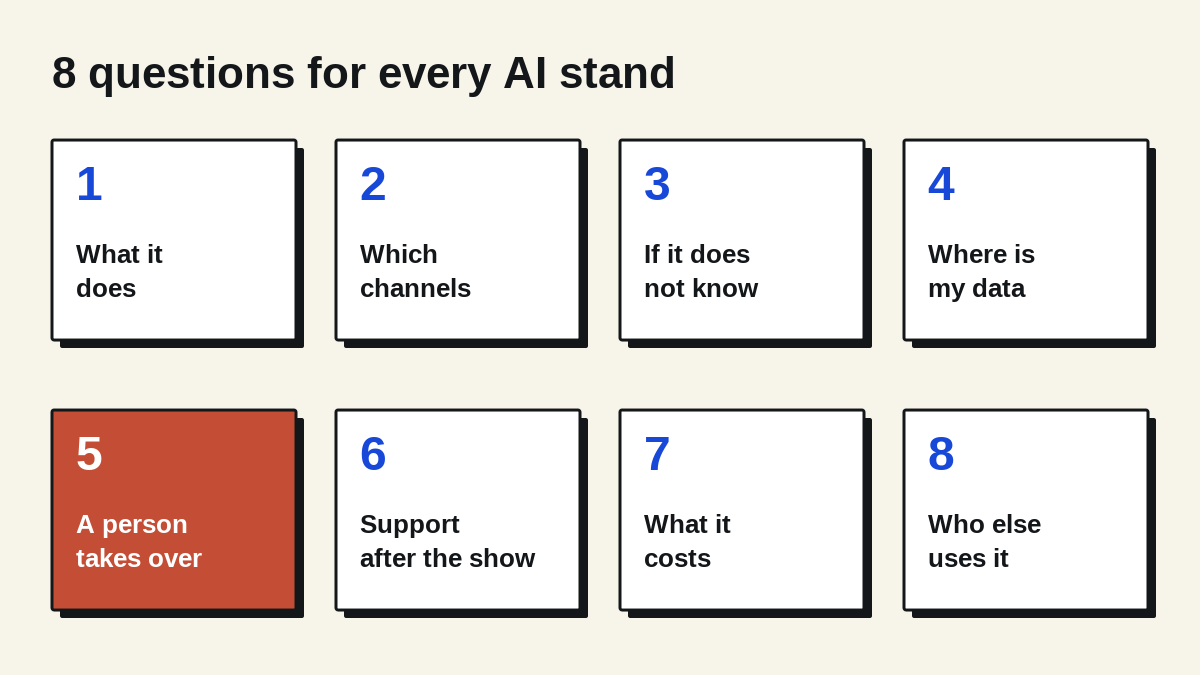
The diagram shows all 8 on one page. The sections below explain each one. Each section gives you the reason to ask, a strong answer and a weak answer.
1. What does it do, and what does it not do?
Why it matters. A stand can show an idea or a product. You need to know which one you see. Ask the team to show only what customers use, on your input.
Strong answer. A short list of products. For each one, the team shows it working on a real input. They say plainly what the product does not do.
Weak answer. "Everything." Or a long list with no demo. Or a promise with a date next to it.
2. Which channels does it cover?
Why it matters. Your customers reach you by website, phone and email. A tool that covers one channel leaves the others to your team. Ask which channels it covers and how they share knowledge.
Strong answer. The team names each channel and shows it. They show that the answers on the website and on the phone come from the same source.
Weak answer. A separate tool for each channel, each with its own set-up and its own bill. You then keep the same answers in 3 places.
3. What does it do when it does not know?
Why it matters. Every AI meets a question outside its facts. A tool that guesses puts your name on a wrong price or a wrong promise. A tool that admits the gap keeps your trust.
Strong answer. The team invites you to ask a question that is not in the facts. The product says it does not have that answer and offers a person.
Weak answer. A confident answer that sounds right and is not in your facts. Or "it always knows". Test it with a question only you can answer.
4. Where is my data hosted?
Why it matters. Your customers give names, phone numbers and questions. You need to know where that data sits and who can see it. If you work with contracts, health or finance, ask for the data terms before you sign.
Strong answer. One plain sentence with a place in it, and an offer to put it in writing.
Weak answer. "It is secure." That is not a place. Ask again.
5. Can a person take over?
Why it matters. An AI will meet a question it cannot answer. What happens next decides if you keep the customer. A good handoff tells the customer what is happening and gets a named person to the chat.
Strong answer. The team shows a customer asking for a person. The customer sees an honest message. A real rep gets a message with the customer's name and contact. Read more in Human handoff from AI chat.
Weak answer. The team never shows a handoff. Or the chat says a person has joined when nobody has. Or nobody is free and nothing happens.
6. Who supports me after the show?
Why it matters. The stand team goes home when the show ends. Your set-up work starts after that. You need a person, not a ticket form.
Strong answer. A named contact, a way to reach that person and a statement of who does the set-up work with you.
Weak answer. "Our website has a help page." Or a promise to send an email "later".
One brain for your company.
It answers your customers, your phone and your team. Book a call: we answer your questions live, on your own website.
7. What does it cost, on paper?
Why it matters. A price said at a noisy stand is easy to forget. A price on paper lets you compare 3 vendors on the same day.
Strong answer. A price in writing. A list of what is included and what costs extra. A statement of whether each product has a separate bill.
Weak answer. "It depends." That is fine as a first step. It is not fine as the final answer. Ask for a quote.
8. Who else uses it?
Why it matters. A customer in daily use tells you more than a slide does. You can only check a result if it has a customer, a period and a number.
Strong answer. A real customer, a period and numbers. The customer has agreed to the numbers.
Weak answer. "Our customers save a lot of time." No name, no period, no number. Ask what the number means and who approved it.
Our straight answers to the same 8 questions
We should pass our own test. Here are our answers. The same answers apply at the stand.
| # | Question | Memox answer |
|---|---|---|
| 1 | What does it do? | 5 products on one brain: website chatbot, voice agent, CRM, handoff to your team and the Memox app. 11 apps connect |
| 2 | Which channels? | Your website, your phone line and your team's apps. The Memox app drafts replies from your connected mail, and you approve each one |
| 3 | When it does not know? | When the knowledge does not cover a question, the chatbot can say so and offer a person |
| 4 | Where is my data? | A data processing agreement (DPA / AVV) is available. |
| 5 | A person takes over? | Yes. The visitor sees "A rep has been asked". The rep gets a phone push, a browser push and an email |
| 6 | Support after the show? | The Memox team sets each connection up hands-on with you |
| 7 | Cost? | Each setup is hands-on, so we price it to your business. You get a clear quote after the call. |
| 8 | Who else uses it? | ContainerOne, an online container dealer. Numbers below |
What "one brain" means for questions 1 and 2
Memox is one brain for the company, and all 5 products run on it. You teach it once from your website, your price rules, your policies and the answers your team gives. A caller and a website visitor get the same answer.
For the plain definition, read What is a company brain?. For the map of products and apps, open the universe.
What the handoff does for question 5
The AI picks a rep in a fixed order, starting with the customer's own rep from the CRM. The visitor sees "A rep has been asked", and the chat never says a rep has joined before that is true. The 4 steps are in human handoff from AI chat.
What we say about data, support and price
A data processing agreement (DPA / AVV) is available.
The Memox team sets each connection up hands-on with you. The 11 apps that connect are Outlook mail, Outlook Calendar, OneDrive, Gmail, other email (IMAP and SMTP), Shopify, GitHub, Jira, HubSpot, Slack and Google Chat. The CRM syncs both ways with HubSpot, and we set that up with you.
Each setup is hands-on, so we price it to your business. You get a clear quote after the call.
What we say about customers
ContainerOne, an online container dealer, uses the Memox website chatbot and approved these numbers. In the 30 weeks to 27 Apr 2026, it had 797 chats and 734 leads, and the AI alone handled 90.6% of the chats. There were 75 handoffs, each with a rep assigned. Read the ContainerOne case study.
Book a 30-minute call. We look at where your leads and customer questions come from today. We show Memox answering on your own website, live on the call. You leave with a plan: what we set up first and which of your tools we connect. Book the call
Red flags in a stand demo
A weak demo is easy to spot if you know where to look. Here are 7 red flags. Each has a follow-up question.
- It is a video. A working product answers a new question. Ask: "Can I type my own question now?"
- No person ever appears. If the team never shows a handoff, you do not know what happens when the AI fails. Ask: "Show me a customer asking for a person."
- The vendor says "everything". No product does everything. Ask: "What does it not do?"
- A number with no source. "Saves hours every week" means nothing without a customer, a period and an approval. Ask: "Who approved this number, and for what period?"
- It never says "I do not know". Ask: "What does it say when the answer is not in my facts?"
- The price is a secret. Ask: "Can I have the price on paper before I leave?"
- Each channel is a different tool. You then keep the same answers in many places. Ask: "Do the website and the phone answer from one source?"
If you see 3 red flags at one stand, walk on.
What to test with Memox
Memox has 5 products, and all 5 run on one brain. For each product, here is one thing to test, at stand H43-R54 or before you go.
1. The website chatbot. Ask us to show a visitor asking the chatbot for a person. Watch what the visitor sees. The chatbot answers day and night from your knowledge, captures the visitor's name and contact and goes on your site with 1 line of code. Your team can take over any live chat. See the website chatbot.
2. The voice agent. Call the demo line: +1 (573) 490-0128. You can also call in the browser on /demo. Ask your own question. The agent picks up in seconds, answers from the same knowledge as the chatbot and keeps a recording and a transcript. See the voice agent and read An AI voice agent for inbound calls.
3. The CRM. Every chat and every call becomes a contact with a stage and a timeline. Nobody types it in. Ask us to show the contact that a chat or a call creates. See the CRM.
4. Handoff to your team. Watch the message "A rep has been asked", then ask what the rep gets: a phone push, a browser push and an email. See handoff.
5. The Memox app. The app runs on iPhone, Android and the web. Type your website address. It reads the site and learns what your business does in about 1 minute. It drafts replies. You approve each email and each invite before it goes. It does not send on its own. See the Memox app.
All 5 products and the 11 apps sit on one map. Open the platform page, the universe or the Expand North Star page to see it before you go.
Worked examples: 3 visitors, 3 first tries
These 3 visitors are invented. The numbers are examples. They show how the same stand serves 3 different needs.
A Gulf trading company director
Say a trading company has 150 staff. It gets 40 calls a day. Many come after the office closes. Nobody answers them, and the director loses orders.
The director tries the voice agent first. The director calls the demo line, asks a price question and checks the answer. The director then asks where the call goes if a customer wants a person. The follow-up list is the part to check.
A European operations lead
Say an operations lead runs a 30-person distributor. The team uses Outlook for mail, Slack for chat and HubSpot for sales. Nobody has time to learn a new tool.
The lead tries the Memox app first. The lead types the company website and watches the app learn the business. The lead then asks how Outlook, Slack and HubSpot connect. The answer: the Memox team sets each connection up hands-on.
A North American service firm director
Say a plumbing firm has 120 people. Visitors write to the website at night and nobody answers until 8 in the morning. The director wants fewer lost leads, not a new tool to manage.
The director asks to see the website chatbot hand a visitor to a person, and reads "A rep has been asked". The director then asks who gets the message. The rep gets a phone push, a browser push and an email with the visitor's name and contact.
Each visitor tests one product on one real problem. Then each asks the 8 questions.
Step by step: the 7 days after the show
The show ends on 10 Dec. The follow-up decides if the visit paid off. Do these steps in order.
- Day 1: sort your notes. Put your 3 stands in a table. For each, write the answers to the 8 questions. Mark each red flag.
- Day 2: write down your real problem. Use one sentence. Add one number from your own business, such as calls a day or chats a week.
- Day 3: ask for the missing answers. Send each vendor the same short email with the questions they left open. Compare how fast and how plainly they answer.
- Day 4: ask for a price on paper. Ask each vendor what is included and what costs extra. Ask if each product has its own bill.
- Day 5: gather your knowledge. Collect your website address, your price rules, your policies and the answers your team gives most. A good AI needs these.
- Day 6: test one more time. Call each demo line again at night, when no sales team is on hand. Check that the answers hold up.
- Day 7: pick one product and one problem. Do not buy everything. Start with one small, clear task and a date to review it.
To continue with Memox, book a call on /demo.
A one-page checklist to take to the stand
Print this table or copy it to your phone. Tick each row at each stand.
| Item | What to do | Done |
|---|---|---|
| Problem | Say your problem in one sentence | |
| Your input | Give your website or a real question | |
| What it does | Ask what it does and what it does not do | |
| Channels | Ask which channels share one source | |
| Unknowns | Ask a question outside your facts and watch the answer | |
| Data | Ask where the data is hosted. Get it in writing | |
| Handoff | Watch a customer ask for a person | |
| Support | Get a name and a way to reach that person | |
| Price | Get a price on paper | |
| Customer | Ask for a named customer, a period and an approved number | |
| Next step | Agree on a date and an owner |
Common mistakes visitors make
1. Visiting every stand. You gain a pile of flyers and no decision. Fix: pick 3 stands before day 1.
2. Letting the vendor drive the demo. A vendor demo shows the best case. Fix: give your own website and your own question.
3. Asking only about features. A feature list does not say who answers at 9 in the evening. Fix: ask the 8 questions, especially handoff and support.
4. Accepting a number without a period. A result with no period and no approval is a slogan. Fix: ask for the customer, the period and who approved the number.
5. Skipping the price. A vague price becomes a surprise in January. Fix: get a price on paper at the stand.
6. Doing nothing after the show. Notes lose value each week. Fix: follow the 7-day plan and book your next step before you leave.
Next step
Memox is at stand H43-R54 at Expand North Star 2026, 8 to 10 Dec. Bring your problem in one sentence. Before you go, open the platform page, the universe or the Expand North Star page.
Book a 30-minute call
- We look at where your leads and customer questions come from today.
- We show Memox answering on your own website, live on the call.
- You leave with a plan: what we set up first and which of your tools we connect.
If it fits, our team does the setup with you. We connect your tools, train the brain on your business and hand you a working system. You do not learn AI.
Each setup is hands-on, so we price it to your business. You get a clear quote after the call.
One brain for your company.
It answers your customers, your phone and your team. Book a call: we answer your questions live, on your own website.
Frequently Asked Questions
Expand North Star (GITEX) is in Dubai, 8 to 10 Dec 2026. Memox is at stand H43-R54.
Ask what it does, which channels it covers, what it does when it does not know, where your data is hosted, whether a person can take over, who supports you after the show, what it costs and who else uses it.
A real demo works on your own input: your website, your question, your call. A fake demo is a video or a fixed script. Ask the vendor to show a person taking over.
You can call the voice agent demo line, type your website into the Memox app and ask us to show a handoff to a rep. All 5 products run on one brain.
Your data is hosted in Germany (EU). Ask every AI company for a plain answer to this question, in writing. A data processing agreement (DPA / AVV) is available.
Book a call on the Memox demo page, or walk up to stand H43-R54. Bring your problem in one sentence.