AI at GITEX 2026: 10 Questions a Company Must Ask at an AI Stand

Key Takeaways
- Expand North Star (GITEX) runs 8 to 10 Dec 2026 in Dubai. Memox is at stand H43-R54.
- One rule beats every other: ask the vendor to show it working on your own business.
- Score each vendor on the same 10 questions, 0 to 2 points each, and compare totals.
- A weak answer on data, handoff to a person or exit should stop the talk, whatever the total.
- Compare 2 tools in 15 minutes by giving both the same 3 real customer questions.
You walk past row after row of AI stands at Expand North Star (GITEX) 2026, and every demo looks good for 3 minutes. Then you cannot say which vendor fits your business. The fix is one rule: ask every AI vendor to show their product working on your own business. Do not accept a demo on invented data. If the vendor cannot do it, you have your answer.
The event runs in Dubai on 8 to 10 Dec 2026. Ten questions, asked the same way at each stand, tell you which vendors deserve more of your time.
This guide gives you the prep list, the 10 questions with strong and weak answers, a score sheet, 7 red flags, a 15-minute method to compare 2 tools and a 7-day follow-up plan. Memox is an exhibitor at stand H43-R54. Ask us the same questions.
The 10 questions in one list
Print this list or save it on your phone. Ask the questions in this order.
- What does the AI answer from?
- Who sets it up?
- How does it hand a chat to a person?
- Where is my data hosted?
- What must my team learn?
- Which tools does it connect to?
- What does it cost?
- Which named customer can I check?
- Who supports me?
- How do I leave?
Each question has one job. Questions 1 to 3 test whether the AI works for your business. Questions 4 and 10 test your risk. Questions 5 to 7 test the effort and the cost. Questions 8 and 9 test whether the vendor will still be there next year.

Before you go: bring 4 things
A vendor with a polished script can make any product look good. Your own material breaks the script. You need four things in your bag.
| Bring | What it is | Why it helps |
|---|---|---|
| 3 problems | The 3 tasks that cost your team the most hours each week | You judge every tool against the same need |
| 5 customer questions | Real questions from your inbox, with the right answer next to each | You can mark an AI answer right or wrong |
| Your tools list | Email, calendar, store, CRM, chat and file tools your team uses | You ask for your tools by name |
| A budget line | The most you will pay each month for the whole team | You can say no to a price fast |
Take the 5 customer questions from the last 2 weeks. Pick a mix: one easy, one with a price rule, one with an exception, one that needs a person and one that your own team answers differently from week to week. The hard ones show the most.
Bring one colleague if you can. One of you asks. The other writes the score. You will forget half of what you hear by lunch, so write it down at the stand.
The 10 questions, one by one
For each question, you get why it matters, what a strong answer sounds like and what a weak answer sounds like. Mark 0, 1 or 2 points when the vendor finishes.
1. What does the AI answer from?
A general AI chat knows a lot about the world and nothing about your refund rule. An AI that serves your customers must answer from your own material: your website, your price rules, your policies and the answers your team already gives.
Strong answer: "It reads your website and your documents. Here is where the answer came from. When the material has no answer, it says so and offers a person."
Weak answer: "It is trained on the whole internet, so it knows everything." That tells you nothing about your business.
Test it with your 5 customer questions. Watch the fifth one, the one your team answers differently each week. A good tool shows its source. A weak tool sounds sure and is wrong.
2. Who sets it up?
Some vendors give you a login and wish you luck. Others set it up with you. Both can work. You need to know which one you are buying before you pay.
Strong answer: "Our team connects your tools and loads your knowledge with you. Here is the plan for week 1, and here is who does each step."
Weak answer: "It is self-service, it takes 5 minutes." Then ask who fixes it when the 5 minutes become 5 days.
3. How does it hand a chat to a person?
An AI that answers every chat to the end will fail on the one angry customer or the one large order. You need a clear rule for when a person takes over, and a clear way to see it happen.
Strong answer: "The AI sees that the visitor needs a person, or the visitor asks. It picks a rep by a rule you can read. The visitor sees that a rep was asked. The rep gets a push and the contact details."
Weak answer: "The AI is so good that it rarely needs a person." Every AI needs a person sometimes.
Ask the vendor to show the handoff on a phone. Ask what the customer sees while they wait. A fair product never says a rep has joined before that is true.
4. Where is my data hosted?
Data location matters to a clinic, a finance firm and any business with customers in more than one region. The answer must be a place, not an adjective.
Strong answer: A named place, said at once, with a plain description of who in your team sees what.
Weak answer: "It is secure and encrypted." Those words do not say where the data sits. Ask again: "In which country is it hosted?"
Ask a second part: who on my team can read a private email or file text? A good product keeps raw material private to the person who connected it. Write down the exact words. You will compare them later.
5. What must my team learn?
Your team already has full days. A tool that needs a course will sit unused by week 3. The best AI fits into the way people already work.
Strong answer: "Nobody needs a course. People ask in plain words. Here is what a new hire sees on day 1."
Weak answer: "We offer a 6-hour training program." That may be fine for a big firm. For a team of 50 or more, it is a warning.
Our post on why your team does not need an AI course goes deeper.
6. Which tools does it connect to?
You use email, a calendar, a store, a CRM and a chat tool. The AI is only as useful as the tools it can read. Ask for your tools by name from your list.
Strong answer: A short list that includes your tools, plus an offer to open one of them in front of you.
Weak answer: "It connects to everything." That is a claim, not a list. Ask the vendor to open one app on your list. If the vendor cannot, it does not connect to it.
7. What does it cost?
A price is not one number. Ask for the price for your whole team, the part that is the AI and the part that is set-up. Then ask what changes if you add 10 people.
Strong answer: A figure or a range, in writing, with what it covers.
Weak answer: "It depends, we will send a proposal." For a team on a deadline, that is slow. Ask for the range in the room.
8. Which named customer can I check?
A case study without a name is a story. A numbered result with a name and a period is something you can check.
Strong answer: A named customer, a clear period, numbers the customer has approved and a way to see the page.
One brain for your company.
It answers your customers, your phone and your team. Book a call: we answer your questions live, on your own website.
Weak answer: "Our customers are in many industries and love it." Ask for one name.
9. Who supports me?
You will need help in week 2, not on the demo day. Ask who answers, and in which hours.
Strong answer: A name or a team, the hours, the channel and what happens after hours.
Weak answer: "There is a help center." That is a library, not a person.
10. How do I leave?
Few buyers ask this and it matters. Ask what you can take with you and how long it takes to stop.
Strong answer: A plain list of what you can export, a plain notice period and no penalty text you must hunt for.
Weak answer: "Why would you leave?" A vendor who cannot discuss the exit has not planned one.
Score the vendor: a one-page sheet
After each stand, go to a quiet corner for 2 minutes and score. Do not wait until the evening. Memory fades fast.
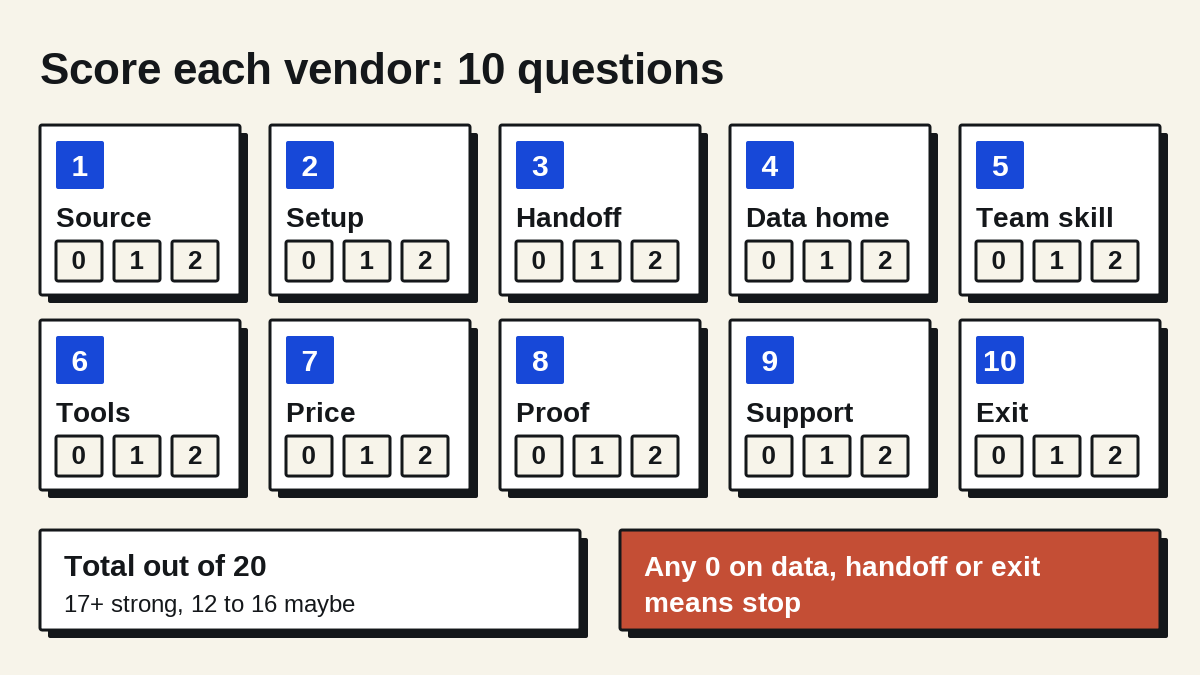
Use this scale for every question:
| Points | Meaning |
|---|---|
| 0 | No answer, a vague answer or a refusal |
| 1 | A partial answer, or an answer with no proof |
| 2 | A clear answer, shown to you, that fits your business |
The total is out of 20. Read it like this:
| Total | What it means | What you do |
|---|---|---|
| 17 to 20 | A strong match | Book a follow-up and start a 2-week test |
| 12 to 16 | A maybe | Ask the weak questions again by email |
| Under 12 | A poor match | Thank the vendor and move on |
Two rules override the total. First, a 0 on question 4 (data), question 3 (handoff to a person) or question 10 (exit) is a stop, even if the total is 16. These three are about risk, and good price does not cancel risk. Second, if you could not test the AI on your own questions, cap the score at 12. A product you have not seen work on your business has not earned more.
Book a 30-minute call. We look at where your leads and customer questions come from today. We show Memox answering on your own website, live on the call. You leave with a plan: what we set up first and which of your tools we connect. Book the call
7 red flags in a stand demo
A good stand is busy and the people are friendly. Friendly is not proof. Watch for these 7 signs, and ask the follow-up next to each.
| Red flag | What it looks like | What to ask next |
|---|---|---|
| Invented data only | Every demo uses a fake shop or a fake clinic | "Can we try it on my website now?" |
| Slides in place of a product | The screen shows a video or a deck | "Can I touch the product on this screen?" |
| No named tools | "It connects to everything" | "Open my email tool, please." |
| Data answered with an adjective | "Fully secure" | "In which country is the data hosted?" |
| No price in the room | "We will send a proposal" | "What is the range for a team of 8?" |
| No person behind the AI | Nobody can say who answers support | "Who do I call in week 2?" |
| No way out | The exit question gets a joke | "What do I take with me if I stop?" |
One flag is a reason to ask more. Two flags are a reason to walk on. Do not feel rude. A good vendor expects these questions, and a vendor who is angry about them has told you what you need to know.
Compare 2 tools in 15 minutes
You do not need a pilot to see a real difference between 2 tools. You need 15 minutes and the same 3 questions at both stands.
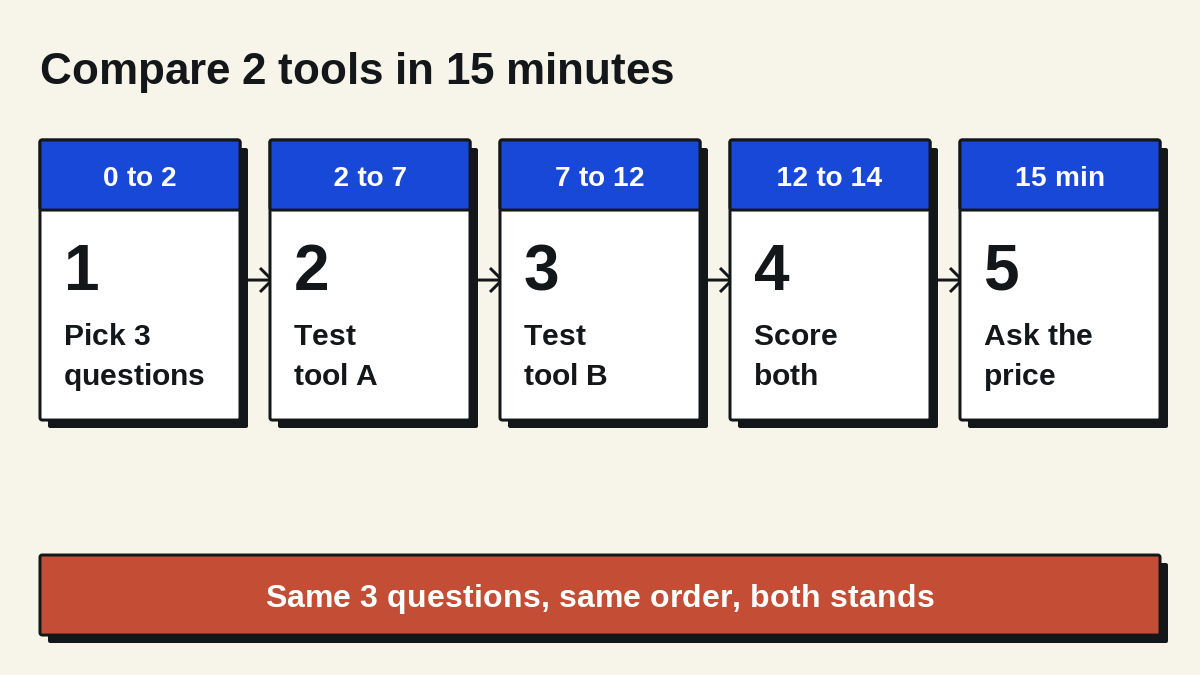
- Minutes 0 to 2: pick your 3 questions. Choose from your 5 customer questions. Keep one hard one. Write the right answer next to each.
- Minutes 2 to 7: test tool A. Ask the vendor to load your website or a document. Ask the 3 questions. Note the minutes the set-up took.
- Minutes 7 to 12: test tool B. Use the same 3 questions in the same order. Note the minutes again.
- Minutes 12 to 14: score both. Mark each answer right or wrong. Mark the 10 questions 0 to 2 on the score sheet.
- Minute 15: ask both for the price. Ask for the whole team, in writing.
The tool with more right answers and fewer set-up minutes is your start. If both tie, the tie-break is the handoff question. The one that handles a person better is the safer choice.
Two worked examples
These two visitors are invented. The numbers show how the score sheet works. They are not real results.
The clinic group ops lead
Say an ops lead runs 3 clinics. Her team gets about 60 calls and chats a day. The 3 problems are missed calls after 6 pm, repeat questions about opening hours and fees, and booking requests that wait overnight.
She tests two unnamed vendors with 5 real questions, one of them about a fee exception.
| Question | Vendor A | Vendor B |
|---|---|---|
| 1. Answers from | 2 | 1 |
| 2. Set up | 1 | 2 |
| 3. Handoff | 2 | 0 |
| 4. Data home | 2 | 1 |
| 5. Team skill | 1 | 2 |
| 6. Tools | 1 | 1 |
| 7. Price | 1 | 2 |
| 8. Proof | 2 | 1 |
| 9. Support | 1 | 1 |
| 10. Exit | 1 | 1 |
| Total | 14 | 12 |
Vendor A scores 14, a maybe. Vendor B scores 12, but it has a 0 on handoff. For a clinic, a chat that cannot reach a person is a risk. She stops with B and asks A to explain its set-up cost by email. She sends the 2 weak questions that day.
The trading company director
Say a director runs a trading company with 90 staff. His 3 problems are slow quotes, a shared inbox that nobody owns and a price list that sits in one person's head.
He tests the same 3 questions at two stands. Vendor C loads his price list and answers 3 of 3 right in 6 minutes, and scores 17. Vendor D answers 1 of 3 right and says the rest needs a week of set-up, and scores 9.
Vendor C wins on the first rule: it worked on his own business. His next step is the 7-day plan below. He asks C for a named customer and the period of the numbers before he signs anything.
After the show: a 7-day follow-up plan
The show is the easy part. Most teams lose the value in the week after. Use this table.
| Day | Action | Time |
|---|---|---|
| Day 1 | Type your scores into one sheet. Write 3 notes per vendor. | 30 minutes |
| Day 2 | Email your top 2 vendors your weak questions. | 20 minutes |
| Day 3 | Ask each for a named customer to check and the period of their numbers. | 15 minutes |
| Day 4 | Book a call with each. Bring the 3 problems. | 15 minutes |
| Day 5 | Ask each for the price in writing for the whole team. | 15 minutes |
| Day 6 | Show the sheet to a colleague who was not at the show. | 30 minutes |
| Day 7 | Pick one. Agree a 2-week test with a clear pass mark. | 30 minutes |
Set the pass mark before the test starts. For example: "5 of 5 customer questions right, and every handoff shows a rep assigned." Without a pass mark, a test drifts and nobody decides.
Where Memox fits
Memox is one brain for your company. It answers your customers, your phone and your team. The website chatbot, the voice agent, the CRM, the handoff to your team and the Memox app all run on that one brain. See the platform and the Memox Universe for the full picture.
Here are straight answers to a few of the questions above.
- Question 1, what it answers from. The website chatbot answers from your knowledge: your website, price rules, policies and the answers your team gives. When the knowledge does not cover a question, it can say so and offer a person.
- Question 2, who sets it up. The Memox team sets each connection up hands-on with you.
- Question 3, handoff. When the AI sees a visitor needs a person, or the visitor asks, it picks a rep: first the customer's own rep from the CRM, then a free rep on the same team, then the next free rep in turn. The visitor sees "A rep has been asked". The rep gets a phone push, a browser push and an email with the visitor's name and contact details. See the handoff page.
- Question 4, data. A data processing agreement (DPA / AVV) is available.
- Question 6, tools. Memox connects to 11 apps: Outlook mail, Outlook Calendar, OneDrive, Gmail, other email (IMAP and SMTP), Shopify, GitHub, Jira, HubSpot, Slack and Google Chat.
- Question 7, price. Each setup is hands-on, so we price it to your business. You get a clear quote after the call.
- Question 8, proof. ContainerOne is an online container dealer that uses the Memox website chatbot. In 30 weeks to 27 Apr 2026, it had 797 chats and 734 leads. The AI alone handled 90.6% of the chats. There were 75 handoffs, each with a rep assigned. Read the ContainerOne case study.
For questions 5, 9 and 10, ask us at the stand and write down what we say.
You can look at the products before you go: the website chatbot, the voice agent, the CRM and the Memox app. The voice agent has a demo number, +1 (573) 490-0128, or you can call in the browser on the demo page.
Common mistakes
- Asking different questions at each stand. You cannot compare the answers. Fix: use the same 10 questions and the same 3 test questions every time.
- Testing only easy questions. Any AI gets the opening hours right. Fix: include one question with an exception and one that needs a person.
- Taking the score at the end of the day. You forget the details. Fix: score in 2 minutes after each stand.
- Trusting a demo on invented data. It proves the product can run, not that it fits you. Fix: ask to load your own website or document.
- Letting price decide first. A cheap tool that fails the handoff test costs more later. Fix: score risk first, then price.
- Skipping the exit question. It feels rude, and it protects you. Fix: ask it at every stand, in the same polite way.
For a deeper look at the knowledge side of this choice, read about AI knowledge management for a team and the questions to ask about an internal knowledge base.
Next step
Bring your 3 problems and your 5 customer questions. Score every stand on the same sheet. Memox is at stand H43-R54. Details are on the Expand North Star page.
Book a 30-minute call
- We look at where your leads and customer questions come from today.
- We show Memox answering on your own website, live on the call.
- You leave with a plan: what we set up first and which of your tools we connect.
If it fits, our team does the setup with you. We connect your tools, train the brain on your business and hand you a working system. You do not learn AI.
Each setup is hands-on, so we price it to your business. You get a clear quote after the call.
One brain for your company.
It answers your customers, your phone and your team. Book a call: we answer your questions live, on your own website.
Frequently Asked Questions
Expand North Star (GITEX) runs in Dubai on 8 to 10 Dec 2026. Memox is at stand H43-R54.
Ask what the AI answers from, who sets it up, how it hands a chat to a person, where your data is hosted, what your team must learn, which tools it connects to, what it costs, which named customer it helped, who supports you and how you leave.
Score the vendor on the same 10 questions and treat a weak answer on data, handoff or exit as a stop. Ask for a named customer and the period of the numbers they show.
Give both vendors the same 3 real questions from your inbox and count the right answers. Note the minutes each one needs to set up. This takes about 15 minutes.
Bring your 3 biggest problems, 5 real customer questions, a list of the tools your team uses and one budget line. These let you test every vendor the same way.
A demo on invented data, a slide in place of a working product and no named apps are red flags. So is an answer to a data question that says only that it is secure.
Memox is at stand H43-R54 at Expand North Star (GITEX), Dubai, 8 to 10 Dec 2026. Plan your visit on the Memox event page.