AI Chatbot for Contractors: Capture Leads 24/7 Without Hiring
Key Takeaways
- Contractors lose an estimated 40-60% of web leads because they can't answer while on job sites. AI chatbots respond in under 5 seconds, 24/7.
- The average HVAC contractor receives 56% of their website inquiries outside business hours, when no one is available to respond.
- AI chatbots for contractors cost $200-500/month, less than a part-time receptionist, and handle unlimited simultaneous conversations.
- The best contractor chatbots do more than collect names: they qualify leads by service type, urgency, location, and budget before routing to dispatch.
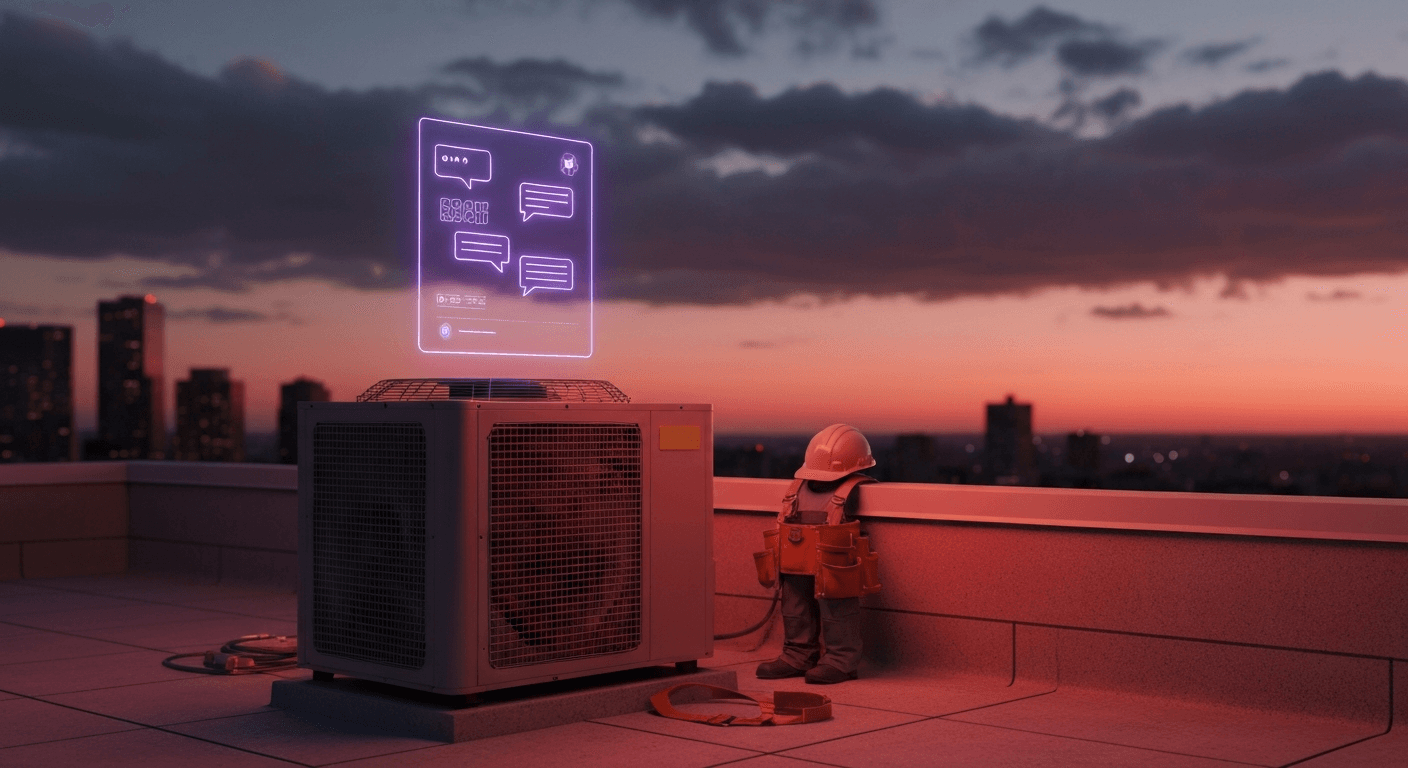
You are on a roof at 2 PM. A homeowner just landed on your website and typed: "Need a quote for a full roof replacement ASAP." By the time you check your phone at 5 PM, they have already booked your competitor.
That is the lead problem every contractor faces, and it has nothing to do with your pricing, your reviews, or the quality of your work. It is a response problem. An AI chatbot for contractors exists to solve exactly this: answer every web inquiry the moment it comes in, qualify the lead, and route it to dispatch while you are still on the job site.
This guide covers how AI chatbots work for home services contractors, what each trade gets out of them, what they cost, and how to pick the right one.
TL;DR: AI chatbots for contractors capture and qualify leads 24/7 while you're on job sites. They cost $200-500/month (less than a receptionist), respond in seconds, and handle HVAC, plumbing, roofing, and electrical inquiries without missing a single lead.
Why Do Contractors Lose More Leads Than Any Other Service Business?
Most businesses that miss a lead do so because they are closed. Contractors miss leads while they are wide open for business. The problem is not office hours. It is that the job site demands your full attention.
Contractors lose an estimated 40-60% of web leads because they cannot respond while on job sites. An AI chatbot for contractors eliminates this gap by responding in under 5 seconds, 24 hours a day.
Here is what makes the math brutal: the average HVAC contractor receives 56% of website inquiries outside business hours, according to NADA research. Add the hours you or your team are on ladders, under sinks, or inside electrical panels, and you are unreachable for a significant chunk of your peak business day.
The response speed issue makes this worse. Harvard Business Review research found that 78% of customers buy from whoever responds first. Not the best-reviewed company. Not the cheapest company. The first one to reply. The average contractor takes 47 hours to respond to a web inquiry, per Vendasta data. A homeowner with a broken furnace is not waiting 47 hours.
Home service leads are also uniquely time-sensitive. When someone searches "HVAC repair near me" or "plumber for burst pipe," they have an active problem. That intent window closes fast. If you are not there within minutes, that lead goes to the next result on Google.
An AI chatbot for contractors does not replace your sales process. It just makes sure leads do not evaporate before you ever see them.
What an AI Chatbot Actually Does for a Contractor
Here is a real scenario. It is 9:14 PM on a Tuesday. A homeowner named Karen visits your website from a Google search for "furnace not working." She is not going to call your office at 9 PM. But she will type a question into a chat box.
The chatbot greets her within 2 seconds. It asks what the issue is. She types: "My furnace stopped working and it's 28 degrees outside." The chatbot recognizes the emergency keywords and shifts into urgency mode. It asks for her address to confirm she is in your service area. It asks whether she has heat anywhere in the house. It captures her phone number and email.
By 9:16 PM, your dispatch inbox has a complete lead: name, address, service area confirmed, problem description, urgency level, and contact info. If you have an on-call technician, the chatbot sends them an immediate text. If not, it tells Karen you will call her first thing in the morning and confirms the callback time.
Karen does not call your competitor. She already feels taken care of.
That is the core of what an AI chatbot for contractors does. It turns website visits into structured, qualified leads, even when nobody on your team is available to respond.
HVAC Contractors
HVAC is the trade with the most to gain from AI chatbots for contractors. Your work is seasonal, your emergencies are real, and your customers have no patience.
During seasonal rush periods, the first cold snap or first heat wave, your phone and website get slammed simultaneously. A chatbot handles hundreds of simultaneous conversations without hold times or voicemail. It asks the right qualifying questions: system type (gas, electric, heat pump), age of equipment, specific symptoms, whether the system is under warranty. By the time you or your dispatcher sees the lead, you already know whether it is a $150 service call or a $8,000 replacement job.
Emergency detection is built in. Phrases like "no heat," "no AC," "gas smell," "furnace not turning on," and "compressor not running" trigger immediate escalation. The chatbot does not bury these in a queue. It flags them for same-day response and captures every detail needed for dispatch.
See how other HVAC contractors are handling 24/7 lead response: HVAC Lead Generation: What Actually Works in 2026 and Equipment Dealers Guide to 24/7 Lead Response Without Hiring More People.
Plumbers
Plumbing leads are among the highest-intent in home services. When someone contacts a plumber, they have a problem that needs fixing, usually today.
A chatbot for plumbers does three things well. First, it handles emergency triage: "burst pipe," "water leak," "toilet overflowing," and "water heater not working" all trigger immediate escalation. Second, it qualifies service area automatically by asking for the zip code before committing dispatch time. Third, it fills your non-emergency schedule by capturing lower-priority requests (drain cleaning, faucet replacement, water heater tune-up) for future booking while you are handling the day's emergencies.
Stay Ahead of the Curve
The dealers winning in 2026 all have one thing in common: speed.
The after-hours value is significant. Plumbing emergencies do not follow business hours. A chatbot that captures a Sunday night lead and confirms a Monday morning callback keeps that homeowner from calling three other plumbers before they hear from you.
Roofers
Roofing has a unique lead pattern: storm events. After a hail storm or high wind event, every roofer in the area gets slammed with website traffic in a 24-48 hour window. Most of that traffic arrives outside business hours and on weekends.
A chatbot for roofing companies turns that surge into a structured lead list instead of a voicemail pile. It captures the homeowner's address, the type of damage (hail, wind, leak), whether the damage is visible from the street, and whether they have had any contact with their insurance company. That last question matters: insurance claim jobs have a different workflow, and knowing upfront saves your sales team time.
Storm surge scenarios are where AI chatbots for contractors prove ROI fastest. A single storm event can generate 50-100 web inquiries in 48 hours. A chatbot handles all of them simultaneously, captures every lead in a structured format, and feeds them directly into your scheduling queue.
Electricians
Electrical leads split into two categories: safety emergencies and scheduled work. A chatbot handles both, but the approach differs.
Safety emergency keywords like "burning smell," "sparks," "circuit breaker tripping," "no power," and "electrical fire" should immediately route to your emergency line or on-call tech with the homeowner's full contact info and address. These cannot sit in a queue. A properly configured AI chatbot for contractors escalates them in seconds.
For scheduled work (panel upgrades, EV charger installation, permit work, ceiling fan installation), the chatbot qualifies the job type, asks about permit requirements, and books a callback or estimate appointment. It can also answer common pre-qualification questions about permit timelines and inspection schedules, which reduces time wasted on calls that are just asking basic questions.
How Much Does an AI Chatbot Cost for a Contractor?
The pricing comparison across your options is straightforward. Here is where each option lands:
| Option | Monthly Cost | Response Time | After-Hours | Lead Qualification |
|---|---|---|---|---|
| AI Chatbot | $200-500/mo | Under 5 seconds | 24/7, included | Full: service type, urgency, location, budget |
| Part-time Receptionist | $1,500-2,500/mo | Minutes to hours | No | Basic |
| Live Answering Service | $200-800/mo + per-call fees | Under 60 seconds | 24/7, often extra cost | Script-based only |
| Voicemail / Nothing | $0/mo | Never (lead lost) | No | None |
The real cost comparison is not chatbot versus receptionist. It is chatbot versus missed leads.
If your average job is worth $1,200 and you receive 20 web leads per month, missing 8 of them (40%) costs $9,600 in lost revenue. An AI chatbot for contractors at $350/month that captures 6 of those 8 missed leads generates $7,200 in recovered revenue, which is a 20x return on the monthly cost.
That math holds even if the chatbot only improves your capture rate by 20%. For a deeper breakdown, see How Much Does a Chatbot Cost? and the Chatbot ROI Calculator.
The part-time receptionist comparison is also worth running. At $15/hour for 20 hours per week, you are spending $1,200-1,500 per month for someone who is unavailable after 5 PM, on weekends, and whenever they are on another call. An AI chatbot costs less than a third of that and works every hour of every day.
How to Choose a Chatbot for Your Contracting Business
Not all chatbots are built for the trades. A generic customer service chatbot designed for e-commerce or SaaS will not understand what "no heat on a 4-ton Carrier" means. Here are the five criteria that matter when choosing an AI chatbot for contractors.
1. Emergency detection and escalation. Your chatbot needs to recognize trade-specific emergency language and respond differently to those conversations. "No AC" in July and "need a fan installed" are not the same urgency level. Make sure the platform lets you configure emergency keywords per trade and define the escalation path (text to on-call tech, email to dispatch, etc.).
2. Lead qualification depth. A chatbot that just collects a name and email is not much better than a contact form. Look for a platform that asks qualifying questions specific to your trade: service type, system age, urgency, service area zip code, and rough budget range. That information is what converts a lead into a booked job.
3. After-hours coverage without extra cost. Some chatbot platforms charge more for 24/7 operation. AI chatbots for contractors should be running at all hours by default, that is the primary use case. If a vendor charges extra for after-hours, look elsewhere.
4. CRM and dispatch integration. The best chatbot in the world is useless if leads end up in a separate inbox you check once a day. Your chatbot should push qualified leads directly into your scheduling system, CRM, or at minimum send an immediate text or email to the right person on your team. ServiceTitan, Housecall Pro, and Google Calendar integrations are table stakes for contractor-focused platforms.
5. Setup simplicity. You are a contractor, not a software developer. Your chatbot platform should set up in under an hour: paste a code snippet into your website, upload your service list, and let the AI learn your offerings. If it requires a month of configuration and a dedicated IT person, it is built for enterprise companies, not trade businesses.
Read How to Choose the Best Chatbot for Lead Generation for a full comparison of platforms across these criteria.
Frequently Asked Questions
How much does an AI chatbot cost for a contractor?
An AI chatbot for contractors costs between $200 and $500 per month depending on features and conversation volume. Memox charges $349/month flat for unlimited conversations with full AI qualification. Basic chatbot builders like Tidio start at $29/month but require manual setup and limited AI capability. Compared to a part-time receptionist ($1,500-2,500/month) or an answering service ($200-800/month with per-call fees), AI chatbots typically deliver a lower cost per captured lead.
Can an AI chatbot handle emergency service requests for HVAC and plumbing?
Yes. AI chatbots can be trained to recognize emergency keywords like "no heat," "water leak," "gas smell," and "no AC" and immediately escalate those conversations. The AI captures the caller's address, describes the issue, and routes the lead to the on-call technician via text or email within seconds. For non-emergency requests, the chatbot qualifies the lead and schedules a callback during business hours.
Do I need technical skills to set up a chatbot on my contractor website?
No. Most modern AI chatbot platforms designed for service businesses require zero coding. Memox, for example, sets up in under one hour: you paste a widget code into your website, upload your service catalog, and the AI learns your offerings automatically. Platforms like WordPress, Squarespace, and Wix all support chat widget installation through their built-in tools.
Every Lead That Hits Your Website Is Worth $500-5,000
You spent money and time getting that homeowner to your website. They searched on Google, clicked your result or your ad, and landed on your page ready to hire someone. That lead is worth $500 on the low end and $5,000 or more for a full system replacement or roofing job.
An AI chatbot for contractors captures that lead for less than $12 per day. It works while you are 30 feet up on a ladder, under a crawlspace, or driving between job sites. It does not take lunch breaks, does not go home at 5 PM, and does not miss calls because it is already on another line.
The contractors who win in 2026 are not necessarily the ones with the best trucks or the most technicians. They are the ones who deploy an AI chatbot for contractors that captures every lead that lands in front of them and responds before the competition even checks their voicemail.
If you are losing leads to competitors who picked up faster, an AI chatbot for contractors is the fix. See how Memox works for HVAC contractors, explore the Memox chatbot, or compare your options with the answering service guide.
Stay Ahead of the Curve
The dealers winning in 2026 all have one thing in common: speed.
Frequently Asked Questions
An AI chatbot for contractors costs between $200 and $500 per month depending on features and conversation volume. Memox charges $349/month flat for unlimited conversations with full AI qualification. Basic chatbot builders like Tidio start at $29/month but require manual setup and limited AI capability. Compared to a part-time receptionist ($1,500-2,500/month) or an answering service ($200-800/month with per-call fees), AI chatbots typically deliver a lower cost per captured lead.
Yes. AI chatbots can be trained to recognize emergency keywords like 'no heat,' 'water leak,' 'gas smell,' and 'no AC' and immediately escalate those conversations. The AI captures the caller's address, describes the issue, and routes the lead to the on-call technician via text or email within seconds. For non-emergency requests, the chatbot qualifies the lead and schedules a callback during business hours.
No. Most modern AI chatbot platforms designed for service businesses require zero coding. Memox, for example, sets up in under one hour: you paste a widget code into your website, upload your service catalog, and the AI learns your offerings automatically. Platforms like WordPress, Squarespace, and Wix all support chat widget installation through their built-in tools.
HVAC, plumbing, roofing, and electrical contractors see the highest ROI from AI chatbots because they share three traits: high-value service calls ($500-5,000+), time-sensitive customer needs (broken furnace, water leak, roof damage), and field crews who cannot answer phones while working. Any contractor who regularly misses calls or website inquiries while on job sites will see immediate lead capture improvement from an AI chatbot.
An AI chatbot qualifies contractor leads by asking targeted questions during the conversation: service type needed (repair, installation, maintenance), urgency level (emergency vs. routine), property location (to verify service area), and budget range or timeline. The chatbot scores each lead based on these answers and routes high-priority leads to dispatch immediately via text or email, while scheduling callbacks for lower-urgency requests during business hours.